

The Social Security Administration is one of the largest federal IT spenders that never makes industry headlines.
It runs roughly $1.2 billion in IT spend per year — $7.8B total since FY2020 — across processing systems that touch nearly every American: retirement claims, disability adjudication, Medicare enrollment, identity verification. Its IT footprint is also one of the oldest in the federal government, which means SSA’s modernization decisions are bigger than most.
What’s interesting is that the biggest event in SSA IT in the past five years happened almost invisibly. A $500M+ prime contract changed hands. Modernization quietly accelerated. And most federal IT vendors never noticed.
We pulled SSA’s IT transactions FY20 through FY26 YTD. Here’s what the data actually says.
The plot twist: Northrop is gone, Leidos is the prime
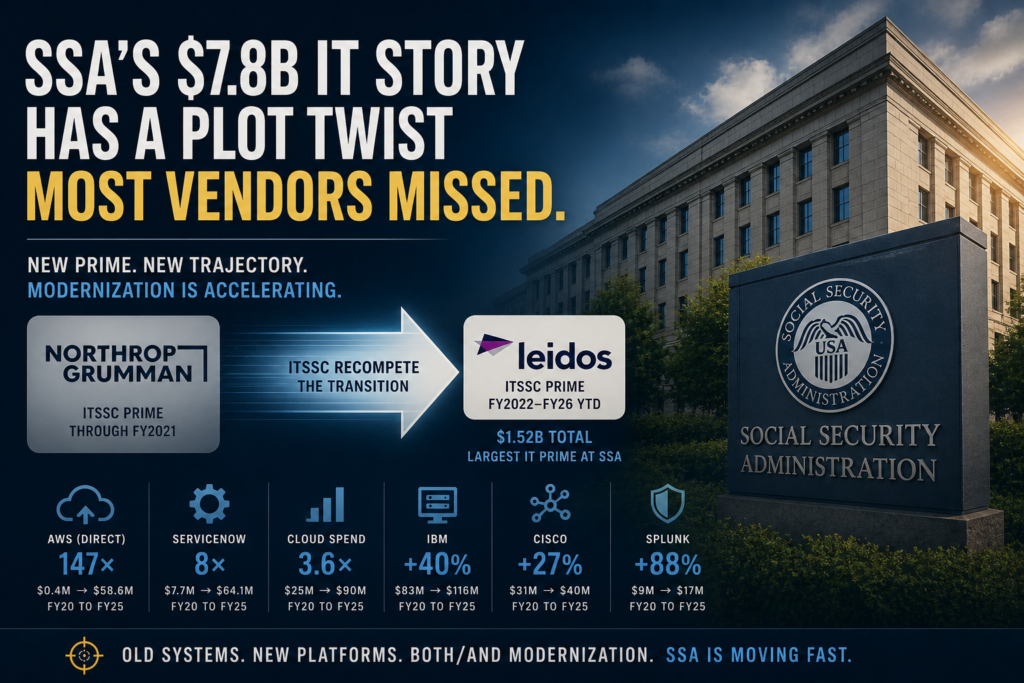
In FY2020 and FY2021, Northrop Grumman was SSA’s largest IT prime contractor, running ~$255M annually under the IT Support Services Contract (ITSSC) — covering systems analysis, network operations, infrastructure support, and most of the day-to-day IT delivery for the agency.
By FY2023, Northrop’s annual spend at SSA was zero.
Leidos won the ITSSC recompete. Leidos jumped from $155M in FY2020 to $305M in FY2022 and has held above $260M every year since. Through FY26 YTD, Leidos has run $1.52B at SSA — almost double the next-largest IT recipient (IBM at $676M).
For federal IT vendors, this single transition matters more than any vendor trajectory. The relationship that drives 30%+ of SSA’s IT spend changed hands. Anyone who built their SSA strategy around Northrop’s relationship circa 2019 has been working an obsolete map for three years.
Five vendor trajectories that tell the modernization story
| Vendor | FY2020 | FY2025 | Change | What’s happening |
|---|---|---|---|---|
| AWS (direct) | $0.4M | $58.6M | 147× | Cloud workloads consolidating at SSA |
| ServiceNow | $7.7M | $64.1M | 8× | Workflow modernization platform |
| Cloud spending (all) | $25M | $90M | 3.6× | Steady multi-year cloud migration |
| IBM | $83M | $116M | +40% | Mainframe + modernization services growing |
| Cisco | $31M | $40M | +27% | Stable network refresh, not declining |
| Splunk | $9M | $17M | +88% | SIEM expanding, not flat |
The pattern that emerges: SSA isn’t replacing legacy infrastructure, it’s adding modern infrastructure on top. The mainframes haven’t gone away — IBM spend is still growing. The networks haven’t shrunk — Cisco spend is up. But cloud, workflow, and observability tooling are growing fast in parallel.
This is a different modernization shape than the cloud-replaces-network pattern we saw at USDA. SSA is doing both/and, not either/or.
ServiceNow won the workflow platform race
ServiceNow at SSA: $7.7M in FY20, $64.1M in FY25 — 8× growth. That’s not a marketing-driven adoption number. That’s procurement infrastructure.
SSA has standardized case management, ITSM, and HR workflows on ServiceNow at scale. Once an agency standardizes at this scale, displacement gets very expensive. The window to compete for SSA workflow modernization closed somewhere around FY22.
For vendors selling adjacent tooling — process automation, low-code platforms, integration middleware — the read is: integration with ServiceNow is now a procurement requirement at SSA, not a feature. Compete on that basis or don’t compete.
The identity story is ID.me, not Okta
Identity and authentication tooling is a $244M line item across SSA in the period. The vendor mix is unusual:
Explore federal IT spending patterns free
Start a FedSpend trial to discover growth opportunities in $675B+ of federal IT awards.
- Deloitte (consulting and integration): $114M combined
- V3GATE: $57M
- ID.me: $24M
- Equifax + Experian (verification services): $20M combined
Notice what’s not on the list: Okta, Ping Identity, Microsoft Entra. The conventional federal identity stack vendors are mostly absent at SSA. The actual identity work is being done through systems integrators (Deloitte, V3GATE) running custom workflows around third-party verification services (ID.me, the credit bureaus).
For commercial identity vendors hoping to sell into SSA: the path doesn’t run through buying CIAM software directly. It runs through whoever wins the next integration services contract.
AWS went from invisible to $58M
AWS direct spend at SSA in FY2020: $400K.
AWS direct spend at SSA in FY2025: $58.6M.
That’s a 147× increase across five fiscal years. SSA crossed the line from “experimenting with cloud” to “running production workloads in cloud” sometime around FY22, and the spending has accelerated every year since.
The AWS growth is happening alongside Microsoft Azure and Google Cloud spending — though smaller — that flows through the systems integrators rather than direct. Total cloud-classified spending at SSA grew from $25M in FY20 to $90M in FY25.
For competing cloud platforms: SSA is moving fast enough that the position you have in 2026 is going to determine your position in 2030. The decisions are being made now.
The procurement personality
Beyond vendor trajectories, SSA’s procurement has its own character:
- Long-cycle prime contracts — multi-year ITSSC vehicles concentrate large amounts of business with single primes (Northrop, then Leidos, eventually whoever’s next)
- Heavy use of OASIS+ and 8(a) sole-source vehicles for specialized IT services
- Concentrated authority — fewer ITAACs and contracting offices than at distributed agencies like Commerce
- Slow buying cycles — proposals 6-9 months ahead of award are common
If your sales motion is built around fast, transactional federal buying, you’ll struggle here. SSA is a relationship and roadmap account.
Why the prime contract handover was invisible
USAspending.gov shows you what was bought and from whom. It does not flag major prime-contractor transitions, even when they’re the largest event in an agency’s IT spend.
If you weren’t watching Northrop’s annual spend at SSA cross from $246M to $9M between FY21 and FY22, you missed the transition. By the time SSA’s RFP for the next-generation IT support contract drops, Leidos will have been the incumbent for four years.
What’s next
We’ll publish the DOE national laboratories analysis next. The data dynamics there are unusual enough to deserve their own treatment — including a $5-10B annual blind spot that’s invisible in conventional federal procurement reporting.
If you sell into SSA, the most useful question this quarter isn’t “what’s our pipeline?” It’s “are we positioned for the SSA that exists in 2026, or the SSA that existed in 2020?” The answer determines your FY27-FY28 revenue more than any pipeline metric.
