


- Manual USASpending research costs two to three hours per agency.
- Generic cold outreach gets deleted before the subject line is read.
- Agency spend data surfaces PSC and NAICS patterns alongside incumbents.
- Spend-anchored outreach reads as informed, not opportunistic, to buyers.
- Research compression frees AEs for more actual pipeline conversations.
Dana used to spend Monday mornings the same way every federal AE does: three browser tabs open to USASpending.gov, a half-built spreadsheet, and a growing sense that the quarter was already behind schedule. The dirty secret of federal sales isn’t that the research takes too long. It’s that rushed research produces outreach so generic that contracting and program office contacts delete it without reading past the subject line. That’s the real cost — not the hours, but what the hours don’t leave room for.
Meet Dana: A Quarter Like Any Other
Dana sells IT services into DoD and civilian agencies for a mid-size systems integrator. New quarter, same pipeline target, same dread. She knows the drill: identify agencies with active spend in her firm’s lane, find the incumbents, get a warm-enough opening line to earn a reply. The target hasn’t changed in three years. The method has to.
The Old Way: Manual USASpending Pulls and Cold Outreach
Here’s what the old Monday actually looked like: log into USASpending.gov, filter by agency and NAICS code, export a CSV, then cross-reference contract vehicles in a second tab because the export doesn’t tell you who’s incumbent. Two to three hours per target agency was normal before a single email went out — and that’s before reconciling duplicate transaction records or figuring out which PSC codes actually map to her firm’s service lines.
| Workflow Step | Manual Research Model | Spend-Data-Driven Model |
|---|---|---|
| Agency selection | Guesswork based on budget headlines | Pattern visibility across obligations by PSC/NAICS |
| Incumbent identification | Manual cross-reference, often incomplete | Surfaced directly alongside spend concentration |
| Time to first email | Hours per agency, spreadsheet-dependent | Minutes, research folded into the platform view |
| Outreach opening line | Generic capability pitch | Anchored to a specific spend pattern or program area |
Why the Research Took So Long
The problem was never that finding every vendor selling into an agency was impossible. It was that doing it manually, agency by agency, ate the exact hours a rep needed for the outreach itself. So the outreach suffered — “Hi, I saw you work in IT services” — and agencies treated it like the noise it was. Response rates reflected it: low, and largely ignored.
The Shift: Bringing Agency Spend Data Into the Workflow
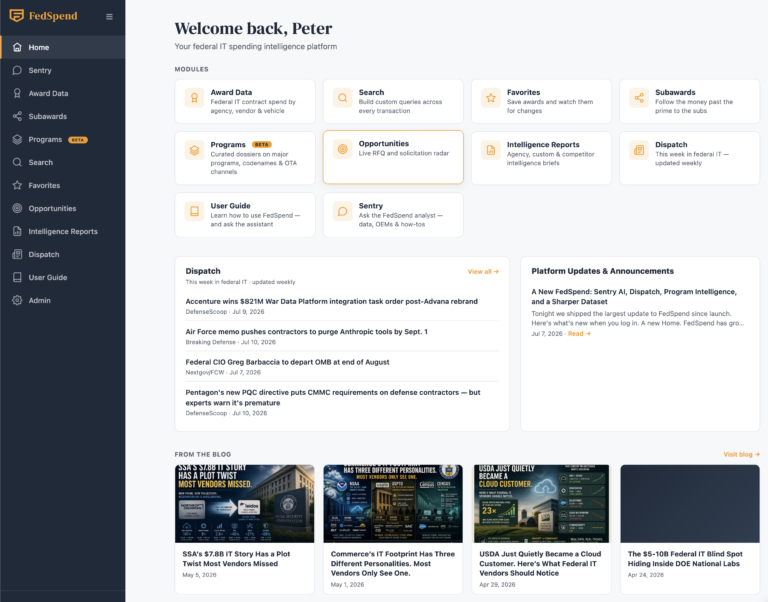
Dana replaced the spreadsheet step, not the strategy. Instead of building her own crosstab, she started looking at agency-level obligations by PSC and NAICS inside FedSpend’s Award Data Platform to see, in one view, where spend actually concentrates.
Take the Department of the Air Force. In fiscal year 2025, per FedSpend’s agency-spend dataset (as of September 2026), the Air Force obligated $12.01 billion across 22,460 IT-related contract actions. The single largest category wasn’t ambiguous — PSC code DA01, business application and development support labor, alone accounted for $2.39 billion.
| Top PSC Category (Air Force, FY2025) | Obligations |
|---|---|
| DA01 — Business application/dev support (labor) | $2.39B |
| DA10 — Business application SaaS | $1.07B |
| 7A21 — Business application software (perpetual license) | $829.8M |
| R425 — Professional support: engineering/technical | $697.3M |
That’s not a performance claim about the tool. It’s a snapshot of where an agency’s own money is already going — the kind of pattern a rep used to need a weekend to reconstruct by hand. Dana’s process now runs in a short sequence rather than a scattershot search:
- Pull agency-level obligations by NAICS and PSC to see where spend concentrates this fiscal year.
- Cross-check which program areas show sustained obligations versus one-off spikes.
- Identify the incumbent(s) tied to that spend before drafting any outreach.
- Draft an opening line that references the actual pattern, not a generic capability statement.
From Spend Pattern to Warm Pipeline Targeting
Incumbent visibility changes what a rep can credibly say in sentence one. Instead of guessing who holds a contract and hoping a program office contact bites on a cold pitch, Dana references the actual spend concentration and program area she’s already seeing. That’s the difference between “I think you might need IT services” and “I noticed your office’s application development spend has stayed concentrated in the same category three years running.”
The second version doesn’t guarantee a reply. Nothing does — federal buyers still move on their own timeline, and incumbents still hold real advantage until a recompete window opens, a signal worth tracking well before a contract’s expiration date. But a message anchored to real obligations data reads as informed rather than opportunistic. Contracting and program staff notice the difference immediately, even when they don’t say so.
Explore $492B in federal IT spend
Try FedSpend free for 14 days. Full dashboard access, no credit card required.
What Actually Changed by the End of the Quarter
Dana’s quarter didn’t transform overnight, and this isn’t a case study with verified performance numbers attached to it — it’s a composite of how the workflow shifts. What changed was allocation and quality:
- Less time lost to spreadsheet reconciliation, more time in actual conversations.
- Fewer “spray and pray” emails sent to agencies with no real spend alignment.
- More targeted conversations concentrated where spend patterns matched her firm’s actual capabilities.
- A first-touch message that opened with something true and specific, instead of a capability statement anyone could send.
Why This Workflow Shift Matters for Federal Sales Teams
The lesson generalizes well beyond one AE’s quarter. Spend data’s highest value isn’t “more leads” — most teams already have more leads than they can chase. It’s compressing research time and raising the specificity of every first-touch message before an agency contact ever sees it.
Audit Before You Add Headcount
Sales leaders evaluating whether a spend-data platform is worth adopting should ask a narrower question first: where is research time actually going right now? This matters even more for teams without a dedicated capture department to absorb the manual overhead — a single rep doing double duty as researcher and closer is exactly who benefits most from compressing that first step. More headcount and more outreach volume are expensive fixes for a research bottleneck that better tooling solves more directly.
Rethinking Your Own Sales Cycle
Ask your own team the blunt version of Dana’s question: how much of this week went to reconstructing data that’s already public, and how much went to conversations? If the honest answer skews toward research, the workflow — not the headcount — is the thing to fix first.
Common Questions About Spend-Data-Driven Federal Sales
Does spend data guarantee a response to cold outreach?
No — spend data improves the relevance and credibility of a first-touch message, but it does not guarantee a reply from a busy contracting or program office contact.
How much research time does a spend-data workflow typically save?
It varies by team and agency complexity, but the time saved comes primarily from eliminating manual spreadsheet reconciliation across USASpending.gov exports and contract vehicle cross-references, not from any fixed universal figure.
Is this different from just using more opportunity-tracking tools?
Yes — opportunity-tracking tools flag upcoming solicitations, while agency obligations by PSC and NAICS reveal the underlying spend pattern and incumbent context needed before that solicitation ever drops.
Do I still need to understand contract vehicles and incumbency?
Yes — spend pattern visibility informs targeting, but understanding the contract vehicle, the incumbent’s position, and the agency’s buying behavior still shapes how and when you approach the account.
The Real Bottleneck Was Never the Data
Every federal AE already has access to the underlying obligations data — it’s public. What most reps lack is the hours to turn it into something specific enough to say out loud in a first email. That’s the actual constraint, and it’s a workflow problem before it’s a tooling problem. Teams that keep buying more outreach volume to compensate for thin research are solving the wrong side of the equation.
