

- HigherGov starts at $500/year; FedSpend uses a trial model
- FedSpend tracks $675B+ in federal IT across 74 agencies
- HigherGov covers SLED, grants, and SBIR; FedSpend does not
- FedSpend scores recompetes 0–100; HigherGov surfaces forecasts only
- Generalist BD shops fit HigherGov; IT-focused capture teams fit FedSpend
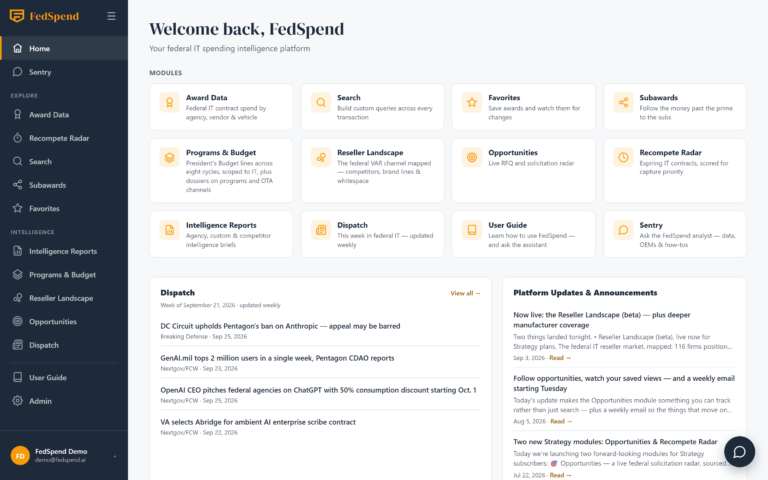
HigherGov will sell a solo capture manager a seat for $500 a year. FedSpend won’t tell you a number until you’ve tried it. That asymmetry is the whole story here, and it’s worth sitting with before anyone opens a credit card. One platform is a broad, affordably-priced government business-development tool that happens to cover federal IT. The other is a narrow instrument built to answer one question: where is federal IT money actually going, and who’s about to lose the contract paying for it. Not the same job, even though both vendors call it “market intelligence.”
What FedSpend and HigherGov Actually Cost
HigherGov publishes three public tiers starting at $500 a year; FedSpend runs a 14-day trial instead of a rate card on its homepage. Per HigherGov’s own pricing page, the Starter plan is a single-user license at $500 a year with basic export and search; Standard runs $2,500 a year for up to 10 users and unlocks market intelligence, forecasts, and AI tools; Enterprise is custom-priced with unlimited users. FedSpend’s pricing page breaks differently: Intelligence and Strategy are the two individual plans, each with a 14-day trial (card required, no CSV export during the trial window), and team seats are billed per-seat at signup with no trial at all.
| Plan | Platform | Starting Price | Seats | Trial |
|---|---|---|---|---|
| Starter | HigherGov | $500/year | 1 user | Available |
| Standard | HigherGov | $2,500/year | Up to 10 users | Available |
| Intelligence | FedSpend | Published rate on site | Individual | 14-day, card required |
| Strategy | FedSpend | Published rate on site | Individual | 14-day, card required |
| Team (either plan) | FedSpend | Per-seat at signup | Team | No trial |
That structural gap matters more than either company’s marketing copy admits. HigherGov wants you to compare sticker prices across its own three tiers. FedSpend wants you inside the data before you compare anything, which only makes sense if the data is the differentiator — not the price.
How Does Federal IT Coverage Actually Differ Between the Two?
HigherGov covers 65 million-plus awards across federal, state, local, and grants; FedSpend covers a narrower slice — $675B+ in federal IT obligations across 2.4M+ transactions and 74 agencies, FY2020 through FY2026 year to date — but decomposes it down to the bureau. That’s not a rounding difference. It’s two different products wearing the same category label.
HigherGov’s market intelligence page markets itself as a way to find federal, state, local, SBIR, and grant opportunities in one place. That breadth is real and useful if a pipeline isn’t IT-specific. But a platform covering everything from highway grants to SLED janitorial contracts has no reason to apply the OMB/GSA Category Management IT definition that separates real IT spend from the custodial and hardware noise dominating most tail-spend conversations. FedSpend applies that filter by design, then goes a layer deeper than the awarding office, to the end-user bureau — the granularity that showed VA’s computer systems design spend concentrating under three dominant codes instead of vanishing into an agency-wide topline.
Explore federal IT spending patterns free
Start a FedSpend trial to discover growth opportunities in $675B+ of federal IT awards.
Where HigherGov’s Breadth Genuinely Beats FedSpend’s Depth
Credit where it’s due: if your firm sells into state and local government, chases SBIR Phase II money, or needs M&A and investor data to vet a teaming partner, HigherGov’s labor pricing benchmarking and partner-finder tools do things FedSpend was never built to do. FedSpend has no SLED coverage, no grants module, and no investor database — full stop.
| Capability | FedSpend | HigherGov |
|---|---|---|
| IT-specific classification (PSC/NAICS + allowlist) | Yes, built-in | No, general govcon scope |
| Decomposition below awarding office to bureau | Yes | Not published |
| Recompete timing with priority scoring | Yes (Recompete Radar) | Forecasts, not scored |
| President’s Budget line items (R-1/P-1/O-1) | Yes (Strategy plan) | No |
| Reseller/OEM channel tracking | Yes (Reseller Landscape) | No |
| State, local, grants, SBIR coverage | No | Yes |
| M&A / investor database | No | Yes |
| In-app AI analyst on live award data | Yes (Sentry) | AI tools (general) |
The Strategy plan turns FedSpend’s IT focus into a channel view HigherGov doesn’t replicate:
- Cross-agency award and subaward search with saved queries and CSV export
- Programs & Budget, down to R-1/P-1/O-1 line items and O&M contracted-IT drill-downs
- Reseller Landscape, mapping VARs and manufacturer brands by firm
- Recompete Radar, scoring contracts by timing and contestability
Which Team Actually Fits Which Platform?
Generalist business-development shops fit HigherGov; teams whose entire pipeline is federal IT fit FedSpend. The honest dividing line isn’t budget, it’s how concentrated your pursuit list already is.
- Count your verticals. If more than a third of your pipeline is state, local, or grant-funded, HigherGov’s breadth earns its price before you open a second tab.
- Check whether you already know your PSC/NAICS footprint. If you’re still guessing which product service codes define your addressable market, a general-purpose award search tool won’t fix that; a platform built around that classification will.
- Ask who needs to see a recompete coming. If your capture cycle depends on catching an IDV before its ordering-period end, you need a tool that scores contestability, not just a forecast flag — the kind we tested directly in our roundup of recompete-tracking tools.
- Decide if channel matters. OEMs and resellers tracking which VARs move their brand through federal contracts need a reseller landscape view that HigherGov simply doesn’t build.
| Team Profile | Better Fit | Why |
|---|---|---|
| Solo BD hire covering SLED + federal | HigherGov | Single-user license at $500/year covers multiple verticals |
| Federal IT capture team, mid-market | FedSpend | IT-specific classification plus bureau-level decomposition |
| OEM or reseller tracking channel partners | FedSpend | Dedicated Reseller Landscape module; HigherGov has none |
| Firm chasing grants and SBIR alongside contracts | HigherGov | Native grants and SBIR search; outside FedSpend’s IT scope |
Neither company publishes a feature list that admits this trade-off directly, which is partly why independent roundups like Civic IQ’s platform comparison keep popping up — buyers are doing the categorization work vendors won’t do for them.
Scope Is the Feature, Not the Limitation
The instinct when comparing two award-data platforms is to ask which one “has more.” HigherGov does — more records, more verticals, more modules bolted onto a decade of govcon feature requests. That’s a legitimate product for a legitimate buyer. But more isn’t the same as sharper, and a federal IT capture team drowning in SLED janitorial contracts and highway grants isn’t better informed, just busier. FedSpend’s bet is that a platform narrow enough to apply one classification standard consistently, and deep enough to follow a dollar past the awarding office to the bureau that spends it, beats a platform trying to be everyone’s answer. For readers whose pipeline is federal IT and nothing else, that bet is the right one.
