

- Late RFP starts cede months of incumbents' relationship advantage
- Effective capture needs 6–12 months of runway, not weeks
- Manual IDIQ spreadsheets decay quickly and miss nested contract structures
- IDV ordering-period ends differ from true recompete solicitations
- Priority scores triage contracts by size, timing, and contestability
Here’s the sentence capture managers don’t say in the Monday pipeline review: by the time the RFP lands on SAM.gov, the deal is frequently already decided. The incumbent has a year of performance data and a working relationship with the program office. Everyone else is reading the solicitation for the first time. That’s not a proposal problem. It’s a tracking problem, and it starts months before most teams admit.
The Pursuit Is Already Lost Before the RFP Drops
Most lost recompetes aren’t lost to a better proposal — they’re lost to a later start. A capture manager who learns about a recompete when the draft RFP posts has 60 to 90 days. One who sees the same IDV’s ordering-period end ten months out has time to shape requirements, build teaming, and run an actual incumbent capture plan instead of a reaction.
The gap is rarely talent. It’s visibility:
| Signal Source | Typical Lead Time | Reliability |
|---|---|---|
| SAM.gov solicitation posting | 30–90 days | High, but already too late to shape |
| Incumbent chatter / grapevine | Variable, often inconsistent | Low — unverifiable, easy to miss |
| Manual spreadsheet of PoP end dates | Theoretically 6–12 months | Low — decays without constant upkeep |
| IDV ordering-period end tracking | 6–12+ months | High, if the vehicle structure is understood |
Why Spreadsheet-Based Federal IDIQ Expiration Tracking Breaks Down
Manual IDIQ expiration tracking fails because contract vehicles don’t expire cleanly — they roll, extend, and nest inside each other. The standard workaround is a spreadsheet built from award notices, a calendar reminder tied to a period-of-performance end date, and whatever an incumbent’s rep lets slip at an industry day. It works for a quarter, then someone leaves and the update stops happening.
The harder failure is structural. A single IDIQ can carry dozens of child orders, each with its own ordering-period end, and an agency exercising an option year on one task order says nothing about whether the parent vehicle faces a true recompete. Calendar-based recompete alerts flag the date; they don’t say whether it’s a real competition or another option year ticking by. That distinction quietly wrecks pipeline accuracy.
How Much Lead Time Does Capture Management Recompete Timing Actually Require?
Effective capture typically needs six to twelve months of runway, not the sixty-to-ninety-day window most teams actually get. GovConWin’s recompete strategy guide frames 18 to 24 months out as “not too early” to start, since the agency may already be drafting acquisition strategy by then.
With real runway, a capture manager works the deal instead of reacting to it:
- Shape requirements conversations before the statement of work locks
- Negotiate teaming agreements while partners are still available
- Build an incumbent capture plan around documented performance gaps
- Develop pricing grounded in the incumbent’s actual cost structure, not a guess
Compare that to the 30-to-60-day reality most teams live in, where the only real choice left is whether to bid at all.
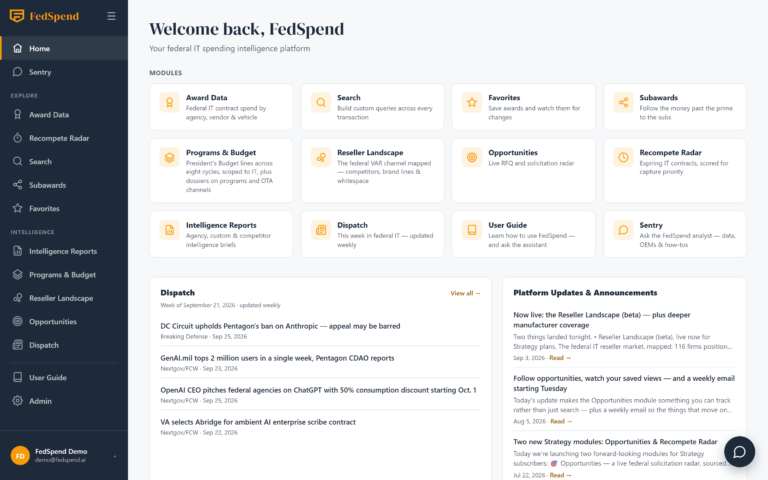
Inside Recompete Radar: How the Priority Score and Time Windows Work
Recompete Radar organizes contracts by recompete timing and assigns each one a 0–100 priority score weighing size, timing, and contestability. Instead of a flat expiration-date list, a capture manager sees which vehicles warrant attention first — a $200 million IDIQ with a vulnerable incumbent scores differently than a $4 million task order coasting through an uncontested option year.
Explore federal IT spending patterns free
Start a FedSpend trial to discover growth opportunities in $675B+ of federal IT awards.
The IDV Shell Blind Spot
The structural piece manual tracking almost always misses is the IDV shell itself, tracked specifically by ordering-period end, separate from any individual task order underneath it. An option year on a child order doesn’t retire the parent vehicle’s eventual recompete, and a tracker built only from task-order award notices will miss it entirely.
The windows map to capture stages, not arbitrary buckets:
| Window | Capture Stage | What Happens Here |
|---|---|---|
| 180+ days | Watch | Monitor priority score, flag for portfolio review |
| 180 days | Plan | Build or refresh the capture plan, start teaming conversations |
| 90 days | Engage | Customer engagement, incumbent displacement positioning |
| 30 days | Pursue | Proposal readiness, pricing finalized |
This sits in the Strategy plan alongside Programs & Budget’s pre-RFP budget signals and the broader Recompete Radar and Opportunities workflow — one picture instead of three tabs.
Turning a Recompete Priority Score Into an Actual Capture Calendar
A priority score is a triage tool, not a prediction — it tells a capture manager where to point effort this week, not who wins in twelve months. Here’s roughly how that triage plays out across a portfolio:
- Pull the weekly priority-score list across every tracked agency and vehicle
- Sort for high size and contestability together — where displacing the incumbent is realistic
- Assign capture ownership to anything crossing into the 180-day window
- Deprioritize high-size, low-contestability scores where the incumbent is simply too strong to dislodge
- Revisit weekly, since a score shifts as obligations and new signals change
A high score means a contract deserves a look, not a guaranteed win. GAO protest records are full of incumbents who held every advantage and still lost on execution.
What Recompete Tracking Can’t Tell You
Recompete tracking is built on public award and budget data, and public data has real, permanent holes. It draws from USAspending, FPDS, and SAM.gov, refreshed monthly. Classified work, OTA member-project dollars, and micro-purchases are structurally invisible — excluded by design because they never reach the public feeds.
Subaward data, pulled from the federal FSRS feed, is partial and lags prime awards. None of this replaces a phone call to the program office. It tells you which program office is worth that call, and roughly when.
Getting Started: Mapping Your Pipeline Against the Windows
The fastest way to know if this changes anything is to run your current pipeline against it. A 14-day Strategy plan trial is enough to pull your target agencies and vehicles, see where they sit against the 30/90/180/180+ windows, and find out how many “late-stage” pursuits were actually visible six months ago. Pricing and trial details sit on the plan comparison page.
Recompete Tracking Is the First Capture Milestone, Not a Housekeeping Task
Most capture organizations file recompete tracking under administrative overhead — something an analyst maintains between real work. That’s backwards. The moment a capture manager learns an IDV’s ordering period is ending is the actual first move of capture, not a notification to acknowledge and forget. Treat it as housekeeping and you’ll keep losing pursuits you never had a real shot at winning, because you showed up to a decision already made. Treat it as the opening move, and the proposal stops being where capture happens — it becomes where capture gets written down.
