


- Solicitations post months after the real opportunity window closes.
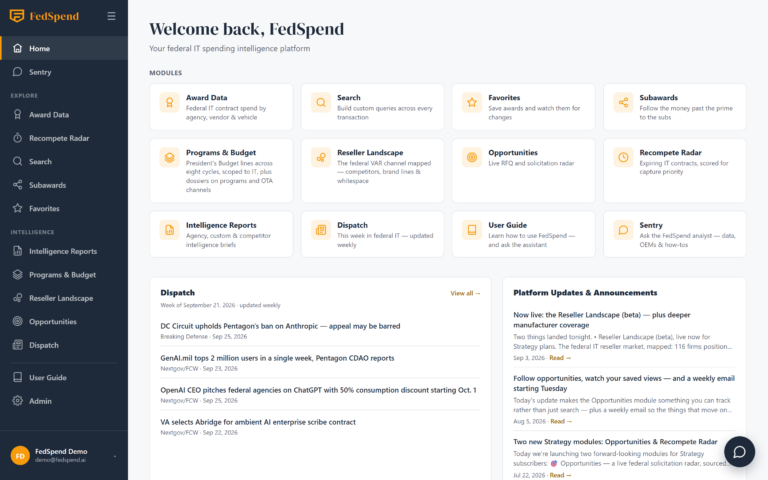
- FedSpend Dispatch pushes curated spend signals directly to your inbox.
- It converts USASpending.gov noise into actionable agency-level signals.
- Sales teams use it to prioritize accounts before RFPs appear.
- Built for vendors and VARs without a dedicated intelligence analyst.
The solicitation you found on SAM.gov this morning was decided months ago. Not by you — by whoever noticed the agency’s budget drifting toward that category two quarters back, warmed the relationship, and shaped the requirement while you were still refreshing your alerts. Public procurement data tells you what already happened. A real federal IT market intelligence newsletter tells you what’s about to. That gap — between the record and the signal — is the entire federal sales game, and most vendors are still playing the losing half of it.
Key Takeaways
- By the time a solicitation posts, the relationship window has usually closed.
- FedSpend Dispatch pushes curated federal spend intelligence to your inbox, not raw data.
- It converts USASpending.gov and FPDS noise into agency-level signals you can act on.
- Sales and channel teams use it to prioritize accounts before contracts appear.
- Built for vendors, VARs, and resellers without a full-time intelligence analyst.
The Federal Sales Intelligence Problem Most Vendors Still Ignore
Federal IT vendors lose deals because they discover opportunities at the solicitation stage, when the decisive work was needed months earlier.
Here’s the pattern I’ve watched for a decade. A team of sharp account executives refreshes SAM.gov, sets keyword alerts, and calls itself fast. Fast isn’t early. By the time a requirement goes public, the incumbent has shaped it and the agency already has a preferred approach. Your proposal is a courtesy bid.
The problem isn’t access. The government floods USASpending.gov and FPDS with transaction-level records — the data is technically public and functionally invisible. Raw feeds are noise until someone tells you which numbers matter — which is how federal IT spending intelligence actually works. Most teams still stitch that together by hand. It eats hours and misses the signal anyway.
What Is FedSpend Dispatch, Exactly?
FedSpend Dispatch is a curated federal IT market intelligence newsletter that turns raw procurement data into a briefing you can act on before contracts post.
It aggregates federal spend data, contract awards, and agency budget signals, then structures them into a short, scannable read built for people who sell — not for analysts who parse. The point is subtraction. Most federal IT activity — the grants renewals, the O&M tails, the micro-purchases — won’t move your number. Dispatch cuts to the fraction that will.
| Approach | What you get | What it costs you |
|---|---|---|
| Raw data feeds (USASpending.gov, FPDS) | Every transaction, unfiltered | Hours of parsing; the signal buried in noise |
| Generic government news digests | Headlines and policy chatter | No account-level relevance, no spend math |
| FedSpend Dispatch | Curated agency signals tied to real obligations | A few minutes; decisions instead of homework |
The Dispatch briefing sits on top of the same award data our analysts use — so the newsletter isn’t a summary of the news, it’s a summary of the money. Miss that line and you’re paying for research that arrives after the decision.
What Federal Spend Updates Does Dispatch Actually Deliver?
The question Dispatch answers every issue: which agencies are closing the gap between contract ceiling and actual obligations, and which ceiling contracts are limping toward expiration — because that gap is where the next award decision lives.
An IDIQ with a $500M ceiling and $40M obligated isn’t a win — it’s a warning about where demand actually is. That gap between what a vehicle can spend and what it has spent is where the real story sits, and plenty of headline contracts are limping along at ten cents on the ceiling dollar. A vendor reading the award announcement sees a half-billion-dollar prize; a vendor reading the obligations sees an agency that hasn’t committed and a category that may never fund. One of those vendors wastes a quarter chasing a ghost.
The federal government will spend roughly $102B on IT in fiscal 2025. About a third of that budget is flagged for new investment rather than keeping the lights on. At $31B, that’s roughly what the entire State Department spends in a year, and right now the momentum is in zero trust and cloud operations — agencies that made those investments in 2022 and 2023 are following with service and support awards on a predictable lag. Dispatch tracks the ones entering that second phase.
- Agency-level category shifts — where an agency’s IT dollars are migrating, and which line items are growing quarter over quarter.
- Contract award signals — who won, at what ceiling, and how actual obligations compare to that ceiling.
- Budget-cycle alerts — the timing cues that show when an agency is entering an active procurement phase.
- Competitive landscape updates — incumbent performance indicators and vendor movement in your segment.
Our deeper agency spending intelligence work goes further, but Dispatch is the feed that keeps it in front of you.
Explore federal IT spending patterns free
Start a FedSpend trial to discover growth opportunities in $675B+ of federal IT awards.
How Do Federal Sales and Channel Teams Use Dispatch to Prioritize?
Teams translate each briefing into three decisions: which accounts to call this week, when to make contact, and what spend numbers to cite when they do.
- Rank accounts by momentum. Direct reps toward agencies whose spend is accelerating in your category, not toward whichever RFP happened to surface.
- Time the outreach. When a budget-cycle alert fires, warm the relationship before the requirement is written — not after.
- Brief the channel. Channel managers use the same spend signals to point resellers at the agencies most likely to buy this quarter.
- Prep proposals on real numbers. Walk in citing obligation trends, not press-release framing.
For teams that want to move from the briefing straight into the underlying records, the full FedSpend platform connects each signal to its transaction-level backup.
Why Does Being Pushed Intelligence Change Federal Sales Behavior?
Nobody blocks an hour for market research when the quarter’s on fire. A push feed doesn’t ask them to.
The week gets busy, the SAM.gov check slips, and a signal goes unread until it’s a lost deal. Nobody schedules their own market monitoring reliably. A briefing that arrives on its own does it for them.
And the advantage compounds. Act on a category shift in the quarter it starts and you have two or three cycles to build position. Notice it when the solicitation drops and you have two weeks. Early isn’t a nicety in federal sales — it’s the whole margin.
Who Is FedSpend Dispatch Built For?
Dispatch is built for federal IT vendors, VARs, and channel partners who manage government accounts but can’t justify a full-time market intelligence analyst.
If you’re a sales director juggling accounts across civilian and defense agencies, you already know the intelligence exists somewhere in the public record. You just don’t have a spare headcount to go dig it out every week. That’s the whole point. Dispatch gives a lean team the market awareness of a research shop it can’t afford to staff. When one account justifies a deeper dive, our deeper intelligence reports run on the same obligation data that feeds Dispatch — so the briefing and the evidence are never from different sources.
How can an IT vendor track federal agency spending without a research team?
The public data exists — USASpending.gov and FPDS archive every transaction. The problem is throughput: parsing those feeds to find category-level momentum in a single agency takes hours a week, and the signal still lags the decision by a quarter. A filtered briefing does that cut before it hits your inbox.
What’s the difference between Dispatch and a government news digest?
News digests report headlines; Dispatch reports the money. Every signal ties back to real contract obligations and agency spend data, so you’re reading where dollars are moving rather than what a press release announced.
How do federal IT resellers monitor government procurement trends with it?
Resellers don’t lose because they’re slow — they lose because they start from solicitations instead of budget signals. The spend data already shows which agencies are two quarters into accelerating in a category; the briefing converts that into a call list before the requirement is drafted.
How often does the briefing arrive?
Dispatch is delivered on a regular cadence built around the federal budget rhythm, so signals reach you while there’s still time to act — not after the window closes.
The Vendors Who Win Federal Aren’t Faster — They’re Earlier
Speed on public databases is a commodity. Everyone has the same alerts, the same refresh button, the same lag. The vendors who consistently win aren’t beating competitors to the solicitation — they saw the budget move a quarter before the solicitation existed. The vendors who’ve figured this out didn’t get smarter — they stopped treating market intelligence as a research project they’d get to someday and started treating it as a line item. A briefing subscription runs a fraction of what one blown proposal costs in staff hours. The teams still waiting for the solicitation are funding their competitors’ early access.
