

- Government IT totals hide sub-agency streams where awards originate
- Federal IT spend reached roughly $102.31 billion in FY2025
- Budget justifications signal buying cycles 12–18 months early
- Zero trust mandates are consolidating civilian cybersecurity dollars
- Match capability to funding stream; time outreach before the RFP
The headline number is where vendors go to lose money. An agency announces a multibillion-dollar technology budget, a hundred capture teams add it to a pipeline slide, and almost none of them can tell you which appropriation line the next award will actually come from. That gap is the entire game. Agency spending intelligence for federal IT vendors is the discipline of reading one level below the press release — into sub-component budgets, modernization mandates, and fiscal-year timing — so you know where a dollar is going before the solicitation confirms it.
Consider the Social Security Administration. Its roughly $7.8 billion technology footprint looks monolithic from USASpending.gov. Up close, cloud migration, legacy COBOL replacement, and cybersecurity consolidation each pull from separate funding streams on separate calendars. Miss that, and you’re bidding blind.
Why Does Agency-Level Spending Data Beat Government-Wide Averages?
Because contracts are awarded by sub-agencies against specific appropriations, not by the aggregate figure everyone quotes. The federal government will spend roughly $102.31 billion on IT in fiscal 2025, with about $30.696 billion flagged as “major investments” — modernization, cloud, and net-new development — per the OMB Federal IT Dashboard. That top line tells a vendor nothing actionable.
What matters is structure. Which bureau holds the money, whether Congress fenced it, and whether it funds steady-state maintenance or a modernization mandate. Reading that layer is exactly what our breakdown of federal IT spending intelligence was built to do — turning invisible transaction records into a map of who buys what, and when.
What Do Federal Agency Budget Documents Actually Reveal?
They reveal intent — an agency’s plans are written down 12 to 18 months before a contracting officer posts anything to SAM.gov. The solicitation is the last event in the chain, not the first.
Where the Real Procurement Signals Live
Three documents carry the freight. Read them in this order:
- Congressional Budget Justifications — the narrative that explains what a number is supposed to buy.
- IT capital planning submissions — the OMB exhibits that flag active investments versus legacy sustainment.
- TechStat and modernization reviews — internal admissions that a system is failing and needs replacing.
Cloud migration announcements and cybersecurity consolidation initiatives are leading indicators, not news. When VA moves EHR workloads to commercial cloud, the follow-on integration and security spend is already telegraphed. Noticing that drift early is the whole premise behind tracking budget movement two quarters ahead of the solicitation. An agency in an active modernization cycle behaves nothing like one in steady-state — and the paperwork says which is which.
Explore federal IT spending patterns free
Start a FedSpend trial to discover growth opportunities in $675B+ of federal IT awards.
Which Five Agencies Are the Best Federal IT Targets in 2025?
SSA, USDA, Commerce, DOE’s national labs, and VA each carry a distinct capability gap a vendor can map to. The table below is the fast read; the notes tell you what each is actually trying to fix.
| Agency | 2025 IT Posture | Capability Gap to Target |
|---|---|---|
| SSA | ~$7.8B environment, urgent legacy modernization | COBOL replacement, multi-year cloud transition |
| USDA | Aggressive cloud-first posture | Enterprise consolidation, rural broadband crossover |
| Commerce | Data-heavy, cyclical | NOAA systems, Census infrastructure, data modernization |
| DOE National Labs | Specialized vehicles | HPC refresh, post-incident cybersecurity investment |
| VA | Sustained cloud migration | EHR integration, identity and access management |
SSA and USDA: Modernization Under Pressure
SSA’s spend is driven by demographic math — the systems paying benefits are decades old and can’t wait. USDA is the more aggressive cloud buyer, and its 2026 moves reward close reading; our look at USDA’s cloud-first modernization roadmap shows an agency consolidating enterprise IT while broadband dollars pull in adjacent infrastructure work.
Commerce, DOE Labs, and VA: The Specialists
Commerce spends in cycles tied to NOAA weather systems and the Census. DOE’s labs buy through unique vehicles and refresh high-performance computing on their own clock, with cybersecurity money spiking after incidents. VA keeps grinding through one of the largest civilian cloud migrations in government. Different doors — same rule: match your capability to the funded gap.
How Is Cybersecurity Consolidation Reshaping Cross-Agency Spend?
Federal zero trust mandates are forcing civilian agencies to consolidate fragmented security tools into unified architectures — pooling dollars that used to scatter. OMB’s zero trust strategy, memorandum M-22-09, set hard targets, and CISA’s Zero Trust Maturity Model gives agencies the scorecard.
That consolidation cuts both ways. For incumbents holding legacy point tools, it’s an extinction event. For challengers with identity, microsegmentation, or continuous-monitoring platforms, it’s a rare chance to displace. The same pattern appears in how agencies are steering purchases toward compliant platforms — the mandate quietly picks winners before the RFP does.
Turn Agency Signals Into a 2025 Pipeline
The vendors who win aren’t the ones with the best data — they’re the ones who act on it in the right order. Run this three-step loop against every target agency:
- Identify the modernization phase — active build, transition, or steady-state sustainment.
- Map your capability to the funding stream — not the headline budget, the specific appropriation.
- Time outreach to the procurement calendar — engage before the requirement is written, not after.
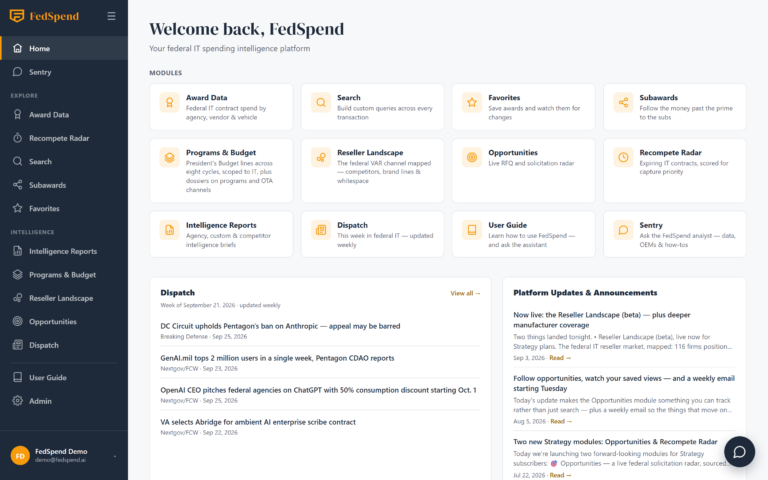
The connective layer is award-level data you can actually query, which is what our award data platform exists to provide. Here’s my position: the aggregate-spend chart in most GovCon decks is theater. The money has a room number, a fiscal quarter, and a name on the door — and the vendors reading that address will keep eating the ones still quoting the headline.
