


- GSAR 552.239-7001 becomes mandatory for LLM contracts October 19, 2026
- Contracting officers can insert the clause into active contracts immediately
- Government data cannot train AI models, run ads, or be resold
- SaaS and AI-feature vendors carry the greatest compliance exposure
- Track DA01, DA10, NAICS 541512 to monitor AI-adjacent federal IT spend
A contracting officer can rewrite the data-handling terms of your AI deal today, under a clause that isn’t mandatory for another two and a half weeks. GSA’s new AI acquisition deviation is live now, optional at a contracting officer’s discretion, mandatory on October 19, 2026. For any federal procurement AI platform play — a chatbot, a document-review tool, anything where an LLM touches government data — that gap is the whole story.
GSA didn’t wait for a final rule. It issued a class deviation contracting officers can use immediately, ahead of formal rulemaking. The countdown to October 19 is not a compliance footnote — it’s a live window.
What GSA’s AI Acquisition Deviation Actually Does
A class deviation is policy, not law — it lets GSA put new contract terms into effect now, skipping the multi-year FAR rulemaking process. The new clause, formally numbered GSAR 552.239-7001, bars contractors from using government data processed in a large language model to train models, feed advertising, or sell to a third party. Contractors must also run encrypted transmission and audit logging, and the government keeps the right to test covered systems for bias and to suspend use at any time.
Why a deviation, not a rule: formal rulemaking takes years; a deviation goes live in months. Washington Technology reports the Oct. 19 date is when the clause stops being optional and becomes default.
| Attribute | Class Deviation (what GSA just did) | Formal FAR Rule (what comes later) |
|---|---|---|
| Speed to effect | Usable immediately by contracting officers | Typically years, via FAR Council process |
| Legal status | Agency policy, in force until rescinded or codified | Binding regulation once finalized |
| Public comment | Already incorporated from prior draft rounds | Separate comment period required |
| Reversibility | GSA can amend or rescind unilaterally | Harder to unwind once codified |
| Applies to existing contracts? | At contracting officer’s discretion | Governed by rule’s own transition terms |
Why This Matters for IT Vendors Right Now
Any proposal touching LLM functionality is operating under a moving target, not a settled clause. The deviation applies when LLM functionality is a material feature of the purchase and government data flows into it — not a contractor’s internal tools, unless the government accesses them or a CO says otherwise.
That scoping is judgment-based, not a checkbox. A contracting officer decides whether your product counts, so assume reviewers may insert the clause into live proposals before October 19, not after.
This mirrors the shift already underway in federal guided buying: agencies expect vendors to know which pathway applies before they ask. Teams that treat this deviation as background noise will reposition last, not first.
Where AI-Related IT Spend Is Already Concentrated
There’s no “AI spending” line item in federal procurement data — but the IT categories AI work rides on already carry tens of billions of dollars. AI-enabled development, chatbots, and document tools get coded like any other application-development or SaaS work: Product Service Codes DA01 (app-dev labor) and DA10 (app-dev SaaS), and NAICS 541512 (Computer Systems Design) and 541519 (Other Computer Related Services).
Explore federal IT spending patterns free
Start a FedSpend trial to discover growth opportunities in $675B+ of federal IT awards.
Four agencies, FY2025, FedSpend agency-spend data as of October 11, 2026:
| Agency | Fiscal Year | Total IT Obligations | DA01 (App Dev Labor) | DA10 (App Dev SaaS) |
|---|---|---|---|---|
| Air Force | FY2025 | $12.03B | $2.39B | $1.07B |
| Navy | FY2025 | $10.07B | $2.00B | — |
| VA | FY2025 | $9.40B | $2.83B | $2.16B |
| Army | FY2025 | $9.41B | $533M | — |
The VA number is the one worth sitting with. VA’s DA10 obligations went from $1.07 billion in FY2024 to $2.16 billion in FY2025 — essentially doubling in a single year, a shift covered in detail elsewhere. SaaS-delivered application work is exactly the kind of contract vehicle most likely to carry AI features into production, which makes VA’s buying pattern an early test case for the clause. Air Force’s footprint tells a similar story: Computer Systems Design Services led its FY2025 PSC and NAICS breakdown at $2.40 billion, the category most likely to absorb AI-enabled integration work.
None of this makes these obligations “AI spend” in a clean sense — IT scope follows the OMB/GSA Category Management IT definition, not an AI-specific tag. Treat it as where dollars concentrate, not what share touches a model.
What Vendors Should Check Before October 19
Waiting for an agency guidance memo is the slowest way to find out your contract changed. Build a checklist tied to the date, not to whenever a program office circulates a notice.
- Pull active task orders and pending proposals where an LLM touches government data; flag which ones a CO could reclassify as “covered.”
- Check data-handling practices against the clause’s core asks: no training on government data, no advertising use, no resale, encryption, audit logging.
- Identify which contract vehicles in your portfolio carry recurring app-dev or SaaS task orders — those are most exposed to a mid-performance clause insertion.
- Name who owns the response if a CO requests compliance documentation on October 20, not October 19.
Two vendor types carry the most exposure:
- SaaS and application-development vendors with AI features already in production
- Resellers bundling third-party LLM tools into larger IT solutions without full visibility into the vendor’s data practices
How to Track Agency-Level AI-Adjacent Spend Going Forward
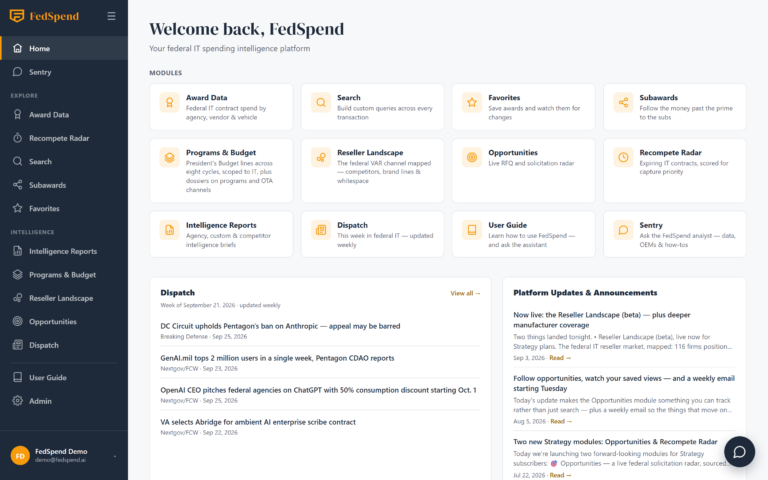
The fastest way to see where this clause will bite is to watch the categories it rides on, agency by agency. FedSpend’s Award Data platform breaks IT obligations down by agency, PSC, NAICS, and contract vehicle, with the Department of Defense split out by component — Air Force, Navy, Army, DLA, and DISA — so a capture team can see whether DA10 growth at one agency is a blip or a pattern before a competitor notices.
Shifts like this arrive as a memo buried in a policy library, not a press release for vendors — the gap Dispatch, FedSpend’s weekly federal-IT digest, closes. For follow-ups against live award data, Sentry answers in-app instead of a fresh export each time. Readers chasing one agency’s pattern can start with its quarterly Intelligence Report.
The Clause Is Small; the Exposure Isn’t
GSAR 552.239-7001 is a few hundred words of contract language. The exposure it creates is not small: any vendor with an LLM feature near government data has a compliance deadline that predates the rule making it permanent. That’s an unusual spot for a regulation to put a market in, and it rewards one behavior — moving before the deadline, not after the memo. Vendors who audit portfolios this month negotiate from readiness on October 20. Everyone else negotiates from catch-up, on terms GSA already wrote without them in the room.
