


- OTA consortium membership costs real money and teaming restrictions.
- The registry shows current member rosters, replacing stale press releases.
- Membership size alone doesn't indicate near-term award volume.
- Planned actions reveal whether active procurements back the consortium.
- Five pre-teaming checks turn guesses into defensible go/no-go records.
Ask a capture manager why their company joined a particular Other Transaction Authority consortium and the answer is almost never a number. It’s a name — a prime they respect, a competitor who got there first. That’s reputation-based teaming, and it’s how systems integrators pay dues without seeing who else is in the consortium or whether the sponsor has real work queued up. An OTA consortium registry exists to close that gap — inside FedSpend’s Programs & Budget module, it sits next to the budget-line and planned-action data telling you whether membership is worth the cost.
The Teaming Decision Most SIs Make With Incomplete Information
Joining an OTA consortium is a real financial commitment, not a courtesy RSVP. There’s a membership fee, a teaming agreement that often restricts who else you can partner with, and the opportunity cost of a BD team not chasing an IDIQ recompete instead.
The problem is structural: there’s no single authoritative roster of who belongs to which consortium, nor a public ledger of what it’s actually won. Rosters live on vendor press pages and LinkedIn — scattered, often stale. Capture teams end up making a real-money teaming decision on the evidence quality of a rumor.
What an Other Transaction Authority Consortium Actually Is, Briefly
An OTA consortium is the vehicle an agency uses to run prototype and production Other Transaction awards across member companies, instead of a single prime contract. Agencies lean on it for speed and terms — IP rights, cost-sharing, milestones — a FAR-bound IDIQ can’t match. That’s the pitch, and why the comparison below matters before committing to either path.
| Factor | Traditional IDIQ | OTA Consortium |
|---|---|---|
| Entry point | Compete at solicitation or recompete | Join via membership/teaming agreement |
| Award basis | FAR-based task/delivery orders | Prototype and production OTAs under the consortium |
| Ceiling vs. activity visibility | Ceiling and obligations trackable in FPDS | Membership visible; project-level dollars largely not |
| Typical cycle time | Months, often with protests | Weeks to a few months |
| Cost to participate | Bid and proposal cost per competition | Recurring dues plus teaming terms |
Where the OTA Consortium Registry Sits Inside Programs & Budget
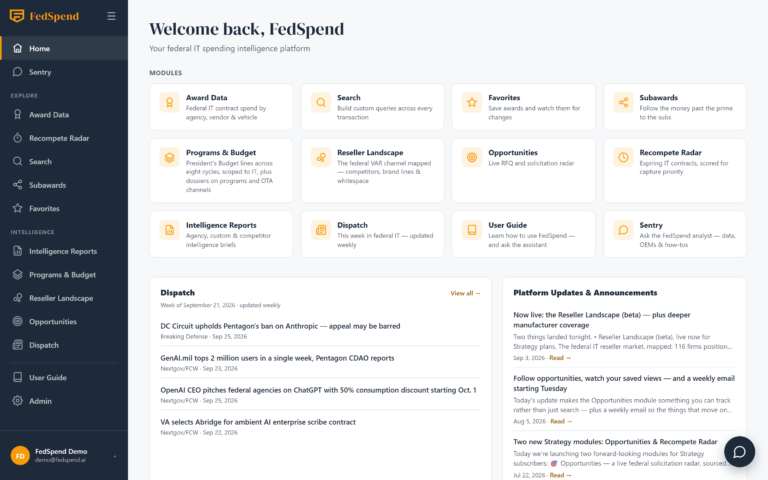
The registry isn’t standalone — it’s one layer inside a module that already shows the budget behind the work. FedSpend’s Programs & Budget module holds the President’s Budget at line level for Defense, from the R-1, P-1, and O-1 exhibits, and at account level for civilian agencies, plus who performs the work, O&M contracted-IT drill-downs, planned actions, curated dossiers, and the Registry.
That’s deliberate: a capture lead researching a defense health OTA consortium shouldn’t leave the tool to check whether the R-1 line behind it is growing or zeroed out. The module came out of beta and was renamed from “Programs” — it’s the context layer for the OTA question, not just a budget-line lookup.
What the Registry Actually Shows About Consortium Membership
The registry surfaces which companies are associated with a given consortium, turning a reputational guess into a checkable roster. Instead of a stale press release, a BD lead can look up the consortium tied to a program and see who’s listed as a member before requesting a meeting. Three competitors already inside versus you being member thirty-one is a different conversation than member six.
Here’s the caveat most vendor content skips: OTA member-project dollars are structurally invisible in federal spend data in a way standard obligations aren’t. The registry is a membership and program-context tool, not a transaction ledger for OTA dollars.
Explore federal IT spending patterns free
Start a FedSpend trial to discover growth opportunities in $675B+ of federal IT awards.
How Do You Pair Membership Data With Planned Actions?
Membership tells you who’s in the room; planned actions tell you whether there’s a live reason to be there. Planned actions are the forward-looking layer inside Programs & Budget — upcoming procurement activity drawn from agency-published sources, distinct from historical obligations. Forty members with no near-term activity behind the sponsoring program is a different opportunity than twelve members with three planned actions queued this fiscal year.
| Signal | What It Tells You | Where to Check It |
|---|---|---|
| Member roster | Who’s already in the consortium, including competitors | OTA Consortium Registry |
| Planned actions | Whether near-term procurement volume exists | Programs & Budget |
| Budget-line trend | Whether the sponsoring program is growing or shrinking | R-1/P-1/O-1 exhibits |
| Agency IT obligations | Directional scale of the sponsor’s broader IT spend | Award Data, by PSC/NAICS |
Run those checks and a consortium goes from a name people mention to a fact pattern defensible in a go/no-go meeting.
Why Teaming Blind on OTAs Is Getting More Expensive
As more agency IT dollars route through OTA consortia instead of traditional IDIQs, skipping diligence before joining is a bigger strategic miss than it used to be. A bad IDIQ teaming call used to cost a proposal cycle. A bad consortium decision now costs dues plus a teaming commitment that can box a firm out of parallel relationships — sunk cost if the activity is thin.
Even with project dollars partially invisible, the agency side isn’t blind. Cross-checking a sponsor’s obligation trend in Award Data by PSC and NAICS gives context: the Air Force obligated roughly $12.02 billion against IT-classified contracts across 22,517 transactions in FY2025, scale signaling whether a sponsor’s budget is growing or flat — the same discipline a reseller team applies to find underserved contracts or when weighing a consortium against a growing IDIQ like OASIS+.
A Practical Pre-Teaming Checklist Before You Pay Dues
Five checks, done in order, turn a teaming decision from a reputational bet into a reviewable record. None guarantees an award; all beat guessing.
- Identify the sponsoring agency and program
- Pull the roster from the OTA Consortium Registry
- Check planned actions for near-term volume
- Review Award Data for the agency’s IT trend
- Use Sentry to ask budget-line questions directly
- Dues are sunk costs if the consortium has thin activity behind it
- Membership size alone says nothing about near-term award volume
This is decision support on public data, not a guarantee. It replaces “I heard they’re worth joining” with a record, the homework a contracting officer already expects a prepared vendor to have done.
The Roster Is Not the Pipeline
A consortium with a long member list and no planned activity behind it is a networking group with a logo. A capture team that can’t tell the difference is making a dues-paying decision on vibes. The fix is checking two signals, before the invoice arrives, not after. Teams treating OTA membership as a reputational purchase in 2026 will keep losing the opportunity-cost argument to teams treating it as a data question. Strategy-plan access to that data costs less than one wasted membership cycle.
