

- Budget exhibits publish a year or more before solicitations appear.
- R-1, P-1, and O-1 each signal a different procurement timeline.
- Justification books name the performing office, not just the agency.
- Planned actions bridge appropriated funds and upcoming RFPs early.
- Quarterly budget reviews give a pipeline advantage over SAM.gov watchers.
By the time a solicitation lands on SAM.gov, the program it funds has already survived a full budget cycle of public scrutiny. The office that will actually use the thing was often named in a justification book anyone could have downloaded a year earlier. Most capture teams never open that document — they wait for the RFP, then scramble to find the real customer afterward. That sequence costs contractors the advantage that matters most in federal BD: time.
Why the Federal Budget Is Your Earliest Contract Signal
The President’s Budget tells you what an agency plans to buy months before a solicitation does. For Defense accounts, that detail lives in the R-1 (research), P-1 (procurement), and O-1 (operations and maintenance) exhibits. Civilian agencies publish account-level justification material with the same logic, if less standardized naming. Both are public, annual, and routinely skimmed instead of read.
| Signal Stage | Document | What It Tells You | Typical Timing |
|---|---|---|---|
| Budget justification | R-1 / P-1 / O-1 exhibit + justification book | Funded program, dollar amount, performing organization | A year or more before execution |
| Pre-solicitation activity | Sources sought, RFI, industry day | Agency scoping a specific acquisition | Weeks to months before RFP |
| Solicitation | SAM.gov notice | Formal requirement, due date, evaluation criteria | Day one of a race everyone else is already running |
A 60-to-120-day stretch from solicitation release to award is standard for straightforward opportunities — and that’s after the requirement is already public. The budget line was public long before that clock started.
Step 1: Start With the Budget Line, Not the Agency Name
Trace the work to a specific funded line before typing an agency name into a search bar. Most BD research starts backwards — “what is DHS buying this year?” — and returns noise. Read the budget at the level it was submitted to Congress: the R-1, P-1, or O-1 exhibit for Defense, sourced directly from the President’s Budget, not a press summary. For civilian agencies, the equivalent is account-level justification material grouped by bureau and activity — same logic, a dollar figure tied to a bureau.
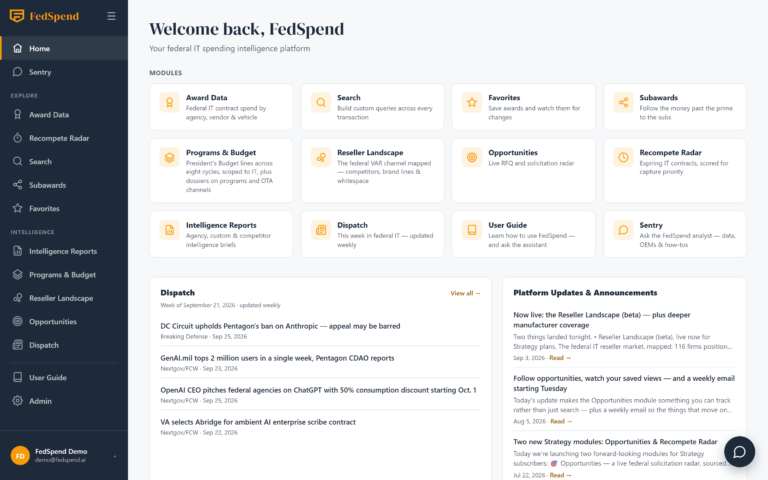
This step gets skipped because it’s tedious across a portfolio of agencies. Programs & Budget makes that line-level view searchable instead of PDF-by-PDF — the only way this becomes a habit, not a one-time sprint.
What Do R-1, P-1, and O-1 Exhibits Actually Mean?
Each exhibit covers a different stage of a program’s life, and which one a line sits in changes how urgently you should watch it. Confusing the three is the most common way BD teams misjudge timing.
- R-1 (RDT&E): research, development, test, and evaluation. Early money — a resulting contract action may still be a budget cycle or two away.
- P-1 (Procurement): funding to acquire a specific capability or system. The clearest near-term signal of upcoming procurement activity.
- O-1 (Operations & Maintenance): funding to sustain what’s already fielded, including a contracted-IT drill-down. Almost always a recurring service that’s under contract now or about to recompete.
The AcqNotes reference on RDT&E exhibits describes the R-1 as the summary document every other RDT&E exhibit must reconcile to — these aren’t independent documents, they’re a hierarchy. A line moving from R-1 to P-1 across budget years is graduating toward a buy. One sitting in O-1 year after year will eventually recompete.
Step 3: Find Who Actually Performs the Work
The office that posts a solicitation is often not the office driving the requirement. Justification books decompose a top-line figure down to the performing organization — often a program office well below the contracting shop that signs the award.
Explore federal IT spending patterns free
Start a FedSpend trial to discover growth opportunities in $675B+ of federal IT awards.
A contracting officer executes paperwork; a program office defines the requirement and lives with the deliverable. Vendors who grasp the difference show up with the right people in the room — contracting officers themselves notice when that homework is done. Decomposing a line down to the end-user bureau separates a researched pitch from a cold one.
Step 4: Check Planned Actions Before SAM.gov Shows Anything
A funded line becomes an actionable lead the moment a planned action is attached to it, well before SAM.gov reflects it. This is the bridge between “Congress appropriated money” and “someone is about to write an RFP.”
Planned actions sit scattered across procurement forecasts and acquisition plans — rarely in one place, never one format. Programs & Budget curates this into a single dossier per line: exhibit detail, performing organization, planned action, no PDF archaeology. That turns background reading into a dated lead, months before a competitor watching SAM.gov alone knows the requirement exists.
Step 5: Pressure-Test the Line With Related Tools
A budget line alone is a hypothesis, not a plan, and three checks turn it into one.
- Search for related history. Pull historical awards or subawards tied to the same program to see who’s already done the work and under what vehicle.
- Check recompete timing. If the line sits in O-1 and a similar O&M requirement exists, Recompete Radar shows where that contract sits against its ordering-period end — a 90-day window or a 400-day one.
- Ask a direct question. Sentry, the platform’s in-app analyst, takes a budget-line question and returns a fast synthesis instead of a manual cross-reference.
This is also where the foothold-contract strategy most capture advice repeats gets grounded in an actual timeline, not a slogan. For integrators, it’s the stage to check whether a program runs through an OTA pathway instead of an IDIQ — worth confirming before a teaming decision, not after.
Turning Five Steps Into a Standing Habit
None of this works as a one-time project — it pays off as a recurring quarterly pass through your priority agencies. Line, exhibit type, performing organization, planned action, pressure-test: five moves, repeatable against ten or fifteen priority lines a quarter. Do it consistently and the SAM.gov feed stops being where your pipeline starts.
Reading the Budget Is a Capture Skill, Not a Compliance Chore
Every capture manager says they want to get ahead of the solicitation. Almost none treat the President’s Budget like the leading indicator it is — they file it under background reading and go back to refreshing SAM.gov. That’s a choice, not a limitation of the data. The exhibits are public. The justification books are public. The only scarce resource is the hour it takes to read them correctly, repeatedly, across a portfolio instead of once a year for one marquee program. That habit isn’t predicting the future. It’s reading a document everyone else already had.
