

- Recompete signals hide in obligation gaps, not expiration dates
- IDV child-order timing often differs from base contract end dates
- GovWin IQ provides analyst-driven context before solicitations post
- Recompete Radar assigns a 0–100 priority score from public obligation data
- No public-data platform can see classified, OTA, or micro-purchase spend
A recompete alert is not intelligence. It’s a calendar entry wearing a software subscription, and plenty of capture teams pay analyst-tier money for exactly that.
The real question isn’t when a contract expires. It’s whether the recompete is worth the five figures a serious proposal costs to write, and that question requires more than a date on a spreadsheet. It requires size, timing, and a read on how contestable the incumbent actually is. This piece compares the two dominant approaches to answering it: Deltek’s analyst-curated GovWin IQ and FedSpend’s newly launched Recompete Radar, which scores every IT contract from public obligation data instead of a human judgment call.
Why Recompete Timing Is a Capture Problem, Not Just a Calendar Problem
A contract with two years left on paper can already be functionally dead. If an agency has burned through most of an IDIQ’s ceiling, the “expiration date” on the award record is noise — the real recompete clock started when obligations stalled, not when the period of performance runs out. That gap between a vehicle’s ceiling and its actual obligations is where a recompete signal hides long before the solicitation posts.
IDV shells make this worse. A base IDIQ’s headline end date rarely matches the ordering-period end on the task orders actually running against it, so any tool that only tracks the base contract is tracking the wrong clock. Here’s what that miss looks like in practice:
| Tracking method | What it shows | What it misses |
|---|---|---|
| Manual FPDS pull | Base contract award and end date | Child-order obligation pace, ceiling burn |
| Calendar/CRM reminder | Static expiration date | Whether the contract is worth chasing at all |
| Analyst forecast (GovWin IQ) | Human-sourced timing and agency context | Transparent, repeatable scoring logic |
| Obligation-scored tool (Recompete Radar) | Size, timing window, contestability score | Classified, OTA member-project, and micro-purchase spend |
What to Look for in a Federal Recompete Tracking Tool
The right tool rolls up IDV child orders, scores priority instead of just listing dates, and prices itself for the size of your capture team. Most published comparisons stop at data breadth. For recompete work specifically, three things matter more:
- IDV child-order rollup — tracking by ordering-period end, not just the base contract’s listed expiration
- Prioritization logic — a way to rank by size, timing, and contestability rather than a flat chronological list
- Pricing that matches team size — per-seat analyst licensing versus a self-serve plan an individual BD hire can justify
A capture manager deciding whether a $14M help desk recompete is worth a proposal needs the same inputs whether they’re reading historical offer counts on similar recompetes or a priority score — the tool just has to surface them fast enough to matter inside a ten-business-day decision window.
How Does GovWin IQ’s Analyst-Driven Forecasting Work?
GovWin IQ pairs a large analyst team with a federal opportunity and forecast database, publishing human-sourced context ahead of a solicitation’s public release. Deltek built the platform around analysts who talk directly to government decision-makers and deliver validated intelligence across federal, state, local, and Canadian markets.
That human layer is the product’s real strength. An analyst can catch a program office’s internal politics, a budget rescission, or a protest rumor that never shows up in obligation data — the kind of agency-specific nuance no FPDS pull will surface. Deltek’s own marketing points to tracked opportunities sitting in the forecast or pre-RFP stage well before SAM.gov reflects them, which is a meaningful lead-time claim if your pipeline depends on relationship-building before a draft RFP drops.
The tradeoff is structural, not a knock on the research quality: analyst-tier coverage comes bundled into enterprise-style subscriptions and modular packages, and that pricing model is hard to justify for a capture shop that only needs recompete timing signals, not the full opportunity-to-proposal suite.
FedSpend’s Recompete Radar: Data-First Scoring Instead of a Human Judgment Call
Recompete Radar assigns every IT contract a 0–100 priority score built from size, timing, and contestability, computed directly from obligation and IDV data rather than an analyst’s opinion. Launched in July 2026, it sorts recompetes into 30, 90, 180, and 180-plus day windows, and it handles IDV shells by tracking the ordering-period end on child task orders — not the base contract’s often-stale headline date.
Explore federal IT spending patterns free
Start a FedSpend trial to discover growth opportunities in $675B+ of federal IT awards.
The logic is deliberately plain: a contract scores higher when it’s large, close to its window, and shows signs an incumbent could be displaced. Nothing about that requires guesswork. It requires someone to pull PSC- and agency-level obligation data — the kind that shows the Air Force obligating $12.0 billion against IT and telecom in fiscal 2025 — and apply the same scoring rule every time.
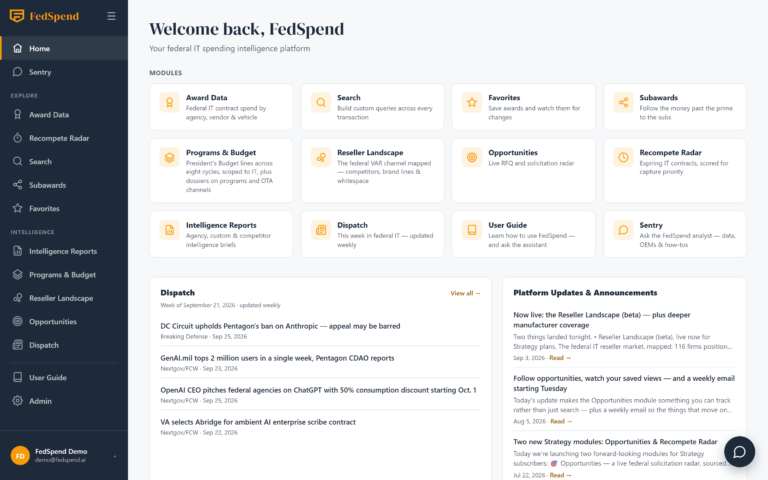
Recompete Radar sits on FedSpend’s Strategy plan, alongside cross-agency Search and Subawards, Programs & Budget, Reseller Landscape, live SAM.gov Opportunities tracking, and commissioned competitive reports assigned per client. Data draws from USAspending.gov/FPDS and SAM.gov, refreshed monthly for award data and several times a day for Opportunities. You can explore how the scoring and windows work on the Recompete Radar product page.
GovWin IQ vs. FedSpend: Which Recompete Tool Fits Your Team?
Choose by how your team buys, not just by what the data covers — analyst-tier licensing and self-serve scoring solve different budget problems. The honest comparison isn’t “which tool is better.” It’s which operating model matches your capture volume.
| Dimension | GovWin IQ | FedSpend Recompete Radar |
|---|---|---|
| Forecasting method | Human analyst research and curation | Scored public obligation and IDV data |
| Entry point | Quote-based, modular packages | Intelligence plan (Award Data, Favorites, Dispatch, agency reports, Sentry) |
| Recompete-specific layer | Analyst-tracked opportunity timing | Strategy plan’s 0–100 score, 30/90/180/180+ windows |
| Buying unit | Team/enterprise licensing | Individual plan or per-seat team plan |
| Trial availability | Demo-led sales process | 14-day trial on Intelligence and Strategy (card required, no CSV export) |
Teams that already pay for Deltek’s ecosystem — Costpoint, Vantagepoint, the full proposal suite — get real marginal value from staying inside it. Teams evaluating a GovWin IQ alternative for recompete tracking specifically, without needing the rest of the BD suite, are the audience Recompete Radar was built for.
How Do You Evaluate a Recompete Score Before You Trust It?
Check whether the score pulls from obligation and IDV data directly, decomposes to the actual end-user bureau, and defines IT scope narrowly enough that it isn’t quietly counting non-IT spend. A contestability score is only as good as what feeds it.
- Confirm the tool reads obligations and IDV ordering periods, not just a static contract end date.
- Check that it decomposes spend to the sub-agency or bureau actually running the program, not the parent department.
- Verify IT scope follows a defined standard, like the OMB/GSA Category Management IT definition, rather than mixing in general services spend.
- Ask what the tool can’t see: classified contracts, OTA member-project dollars, and micro-purchases are invisible to any public-data platform, FedSpend included.
That last point matters more than vendors like to admit. The same discipline applies whenever a platform makes a predictive claim from public data — it’s worth the same scrutiny applied to any vendor’s predictive-analytics claims before a capture team builds a pipeline decision on top of it.
Getting Started With Recompete Tracking Tools
The lowest-commitment way to test obligation-based scoring against your current process is the 14-day trial on FedSpend’s Intelligence or Strategy plan. A card is required, and CSV export is off during the trial window, but the scoring, windows, and IDV rollup are live.
Pull your current recompete watchlist, run it against Recompete Radar’s windows, and see where the two lists diverge. If you’re also tracking live solicitations rather than pre-solicitation signals, pair it with Opportunities, which refreshes several times a day against SAM.gov — a useful complement to checking award changes without re-pulling USAspending every week.
The Scoring Argument Beats the Subscription Argument
Analyst judgment isn’t wrong — it’s expensive, and it’s opaque in a way that’s hard to justify once you ask a vendor to show their work. A 0–100 score built consistently from obligation and IDV data will miss the political nuance a good analyst catches. But it will also tell you, every time, exactly why a contract scored the way it did. For a mid-market capture team deciding between five recompetes and a proposal budget for two, that transparency is worth more than a subscription’s worth of relationship-building the team can’t afford to wait for anyway.
