

- Federal Compass manages capture after an opportunity is identified.
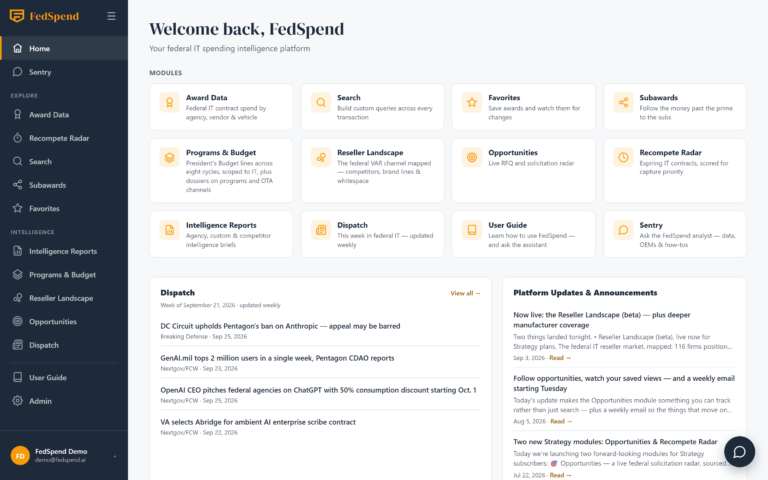
- FedSpend surfaces IT budget targets before capture begins.
- FedSpend covers $675B+ in federal IT obligations across 74 agencies.
- The two tools barely overlap — workflow vs. data layer.
- Most teams eventually need both, in sequence.
Two sales reps pitch almost the same line this quarter: “see your next federal win before the competition does.” One is selling a CRM built on your own pipeline data. The other is selling access to $675B+ in federal IT obligations across 2.4M+ transactions and 74 agencies, enriched down to the bureau and the contract vehicle. Federal Compass and FedSpend both land on the same shortlist because buyers sort “federal intelligence tools” into one bucket. They don’t belong there — conflating them means a BD budget pays twice for the same job.
The Comparison Everyone Gets Wrong
Federal Compass manages the capture process once a target exists; FedSpend finds and ranks the target before capture starts. That’s the entire distinction, and it’s why a feature-for-feature fight between the two wastes an afternoon.
Both tools market to the same buyer — a BD director or capture manager. One starts after the opportunity is identified. The other’s job is identifying it, down to the bureau controlling the budget line and the recompete window it’s about to hit.
| Dimension | Federal Compass | FedSpend |
|---|---|---|
| Core job | Run capture: pipeline, teaming, proposals | Find where IT budget sits and when it recompetes |
| Primary data | Opportunities your team enters | Enriched public award, budget, solicitation data |
| Deployment | Sales-led, demo and contract onboarding | Self-serve, 14-day free trial |
| Best suited for | Repeatable deals, no shared workflow | Teams unsure where the opportunity is yet |
What Federal Compass Actually Does
Federal Compass is a sales-led capture management and CRM suite built for contractors running a structured BD process. Its team’s pedigree traces to GovWin and INPUT, the research shops that effectively invented commercial federal opportunity tracking — which shows up in a product built around a disciplined capture lifecycle, not a generic sales CRM with federal fields bolted on.
The value proposition is workflow, not discovery. Once an opportunity is identified — from SAM.gov, a relationship, or elsewhere — Federal Compass helps a team manage pipeline stage-gating, teaming tracking, color-team scheduling, and proposal task assignment. It’s the system of record for “who is doing what, by when.”
That makes it a post-identification tool. It won’t surface which bureau is sitting on unspent IT money, or flag a contract months before it hits the street. For a capture manager with a pipeline but no shared workspace, that’s the gap worth closing — a different gap than a spend-intelligence platform closes.
What Is FedSpend, and Why Is It a Different Category Entirely?
FedSpend is a self-serve federal IT spend intelligence platform, not a CRM, not a tracker of all federal spending. Its scope follows the OMB/GSA Category Management IT definition — IT-coded NAICS and PSC categories plus a curated allowlist — narrower than “every federal dollar,” deeper than a generic award search tool.
The value isn’t the raw data — USAspending.gov and FPDS already publish that. It’s the enrichment layered on top inside FedSpend’s award data platform: forward-looking signals, decomposition below the awarding office to the end-user bureau, and correlation across sources that don’t natively talk — awards, subaward filings, SAM.gov solicitations, and President’s Budget exhibits.
FedSpend ships in two plans. Intelligence covers the baseline: Award Data, Favorites, Dispatch, agency quarterly Intelligence Reports, and Sentry. Strategy adds the forward-looking layers: Search and Subawards, Programs & Budget, Reseller Landscape, Opportunities, and Recompete Radar, plus commissioned OEM and reseller reports assigned per customer.
Explore federal IT spending patterns free
Start a FedSpend trial to discover growth opportunities in $675B+ of federal IT awards.
| Feature | Intelligence | Strategy |
|---|---|---|
| Award Data (agency, PSC, NAICS, vehicle) | Included | Included |
| Dispatch + Sentry AI analyst | Included | Included; Sentry also answers budget-line questions |
| Agency quarterly Intelligence Reports | Included | Included |
| Search, Subawards, Programs & Budget | — | Included |
| Opportunities + Recompete Radar | — | Included |
| Reseller Landscape + commissioned reports | — | Included |
A full breakdown of what each tier is built for, including how FedSpend prices the Intelligence and Strategy plans, is worth reading before committing to a seat count.
Where the Two Jobs Actually Diverge
Line the capabilities up and the two products barely overlap. Federal Compass owns the workflow layer; FedSpend owns the data layer underneath it.
| Capability | Federal Compass | FedSpend |
|---|---|---|
| Pipeline / CRM stage tracking | Core function | No equivalent |
| Teaming & proposal workflow | Core function | No equivalent |
| PSC / NAICS / vehicle award data | No equivalent | Core function |
| Recompete priority scoring | No equivalent | Recompete Radar |
| Bureau-level budget lines (R-1/P-1/O-1) | No equivalent | Programs & Budget |
| Reseller / channel mapping | No equivalent | Reseller Landscape |
That last row matters more than it looks. An OEM trying to figure out which resellers are actually moving its product has no analog inside a capture CRM. The reverse is true too: nothing in FedSpend assigns a proposal task or tracks which partner owes a capability statement by Friday — that’s a workflow problem, and workflow problems need a workflow tool.
Who Should Choose Federal Compass, FedSpend, or Both?
Start from the pain, not the vendor name.
- “We win deals but nobody can tell you the stage of any of them” — Federal Compass territory.
- “We don’t know where IT budget is moving, who’s about to recompete, or who the reseller landscape favors” — FedSpend territory.
- Both are true often enough that many teams need both, at different stages.
Mid-size GovCon teams land here eventually: FedSpend to find the target — a category also benchmarked against GovTribe and HigherGov — and a CRM to run the deal once qualified.
- Ask whether the bottleneck is finding opportunities or managing the ones already found.
- Check whether your team can name the bureau and recompete window for its top five contracts without a hand-built spreadsheet.
- If not, test the data layer first — a 14-day trial on FedSpend’s Intelligence or Strategy plan needs a card but no contract.
Honest Limits to Know Before You Buy
Neither tool does everything, and the gaps matter more than marketing copy. FedSpend covers IT spend, not all federal spending; classified spend, OTA member-project dollars, and micro-purchases stay structurally invisible.
- Subaward data follows the FSRS feed — partial, and lagging behind prime awards.
- CSV exports are quota’d by plan, not unlimited; the trial excludes export entirely.
- Most data refreshes monthly; Opportunities refreshes several times daily instead.
Federal Compass’s limit is structural: sales-led means a demo and contract before evaluation, a different buying motion than self-serve signup.
The Real Question Isn’t Which Tool Is Better
It’s which stage of your pipeline is underserved. A team drowning in untracked teaming agreements needs Federal Compass, not more data. A team great at proposals but blindsided by recompetes needs FedSpend’s bureau-level visibility, not a better CRM. Buy for the gap you have, not the category label on the homepage.
