

- Agency rollups hide which bureau actually consumes IT spend.
- $675B+ in federal IT obligations tracked across 2.4M transactions.
- IDV child-order rollups reveal durable, recurring contract revenue.
- PSC and NAICS codes alone inflate or misclassify IT tail spend.
- Recompete timing, size, and contestability must be weighed together.
Every capture team has run the same exercise: pull an agency’s top 20 IT awards and call it market intelligence. What that misses is the task orders, BPAs, and recurring IDV draws that sit below the awarding office and renew, year after year, without anyone outside the program office noticing. That’s federal tail spend, and the agency-level view is the wrong altitude to see it from.
What Federal Tail Spend Actually Means — And Why Agency Totals Hide It
Federal tail spend is the long list of smaller, fragmented IT purchases sitting below the handful of headline awards that dominate an agency’s procurement news. It’s not a rounding error. FedSpend’s refreshed federal IT dataset tracks $675B+ in obligations across 2.4M+ transactions and 74 agencies from FY2020 through FY2026 year-to-date, and most of those transactions never attract a second bidder, let alone a press release.
The deeper problem is structural. The office that signs a contract on USAspending.gov is often not the bureau that consumes the IT. That gap is where tail-spend analysis quietly breaks down.
| View | What it shows | What it hides |
|---|---|---|
| Agency-level rollup | Total obligations by department | Which bureau actually consumes the IT |
| Awarding-office data | Who signed the contract | Recurring buying patterns by end user |
| Bureau-level decomposition | Repeat categories, repeat vendors, by consuming unit | Nothing — this is the missing layer |
This piece works three lenses — agency, bureau, contract length — because each hides a different opportunity.
The Bureau-Level Blind Spot in Federal IT Spend
Decomposing spend below the awarding office to the actual consuming bureau reveals concentrations that standard FPDS and USAspending rollups don’t surface. Public feeds report who signed the contract, not which sub-agency or bureau issues task orders against it year after year.
Why Bureau Visibility Changes Capture Strategy
Smaller bureaus often repeat-buy the same narrow category — endpoint hardware, help-desk labor, a software suite — without any consolidated strategy tying those purchases together. No one at headquarters is optimizing that spend; it just happens, the same way it happened last fiscal year. That repetition is what makes it findable.
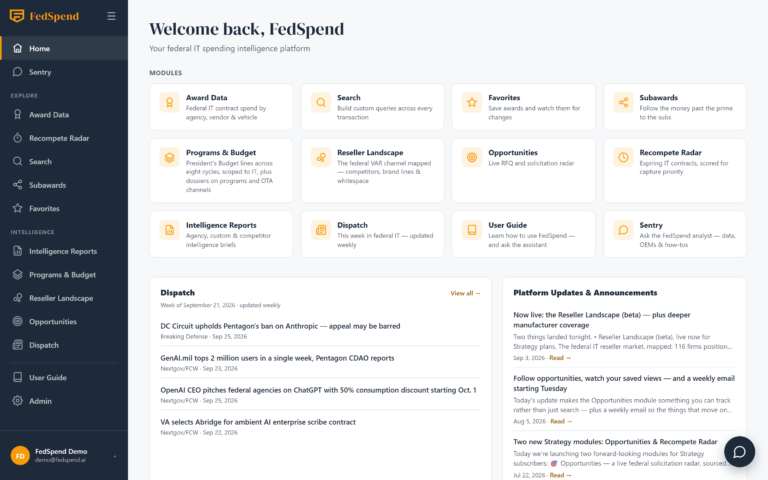
A closer look at how concentrated VA’s IT buying has become under a single NAICS code shows how much vendor concentration can hide inside one department once you stop reading the top-line number and start reading who’s actually consuming the category. Getting there requires enrichment beyond raw public data, which is what FedSpend’s Award Data platform does by breaking out IT spend to the bureau, PSC, NAICS, and vehicle level.
Why Long-Running Contracts Quietly Dominate the Tail
Individual task orders look like noise, but rolled up under their parent IDV they represent some of the most durable, predictable revenue in a federal IT portfolio. A $400,000 order against a ten-year-old BPA looks like tail spend alone. Roll up every order under that vehicle since inception, and it’s often a contract that has outlasted three agency reorganizations.
Explore federal IT spending patterns free
Start a FedSpend trial to discover growth opportunities in $675B+ of federal IT awards.
IDV Child-Order Rollup, Explained Simply
An IDV — an indefinite-delivery vehicle — sets a ceiling; the child orders placed against it are where actual obligations land. Tracking only the child orders misses the durability story. Tracking only the ceiling misses that most IDVs never come close to spending it.
| Lens | What you see | Why it misleads alone |
|---|---|---|
| Single task order | One modest obligation | Looks like immaterial tail spend |
| IDV ceiling | A large headline number | Often far above actual obligations |
| Rolled-up child orders | Cumulative, recurring obligations over years | The real signal — durable, winnable spend |
That durability has a shelf life. Every ordering period eventually ends, and a long-ignored tail award becomes a near-term opportunity for a vendor that was never on it. Much of what gets labeled “tail spend” in casual analysis is actually long-running vehicles nobody is watching for the moment they come back to market.
Where Recompete Timing Turns Tail Spend Into a Pipeline
Tracking contracts by how soon they recompete — inside 30, 90, 180, or beyond-180-day windows — turns tail spend from a backward-looking label into a forward-looking pipeline. Most capture teams treat tail spend as a category to describe, not a calendar to work.
- Flag ordering-period end dates across the IDVs and BPAs a vendor cares about, not just the prime awards.
- Weight each contract by size — cumulative obligations under the vehicle, not the latest task order.
- Score contestability — incumbent concentration, set-aside status, whether the requirement has drifted since the last award.
- Prioritize the overlap of near-term timing, meaningful size, and real contestability — not any one factor alone.
That last step is the one most teams skip. A contract recompeting in 30 days but worth $80,000 a year isn’t worth a proposal team’s time; a $40 million recompete three years out isn’t worth tracking weekly. Weighing all three together is the logic behind Recompete Radar’s priority scoring, which assigns a 0–100 score and tracks IDV shells by ordering-period end — rather than rediscovering recompete dates after a solicitation has already posted.
Classifying IT Tail Spend: Why PSC and NAICS Codes Alone Fall Short
Strict IT classification — not a raw NAICS or PSC pull — separates true IT tail spend from adjacent categories that inflate or hide the real number. The government’s own category management framework defines IT spend using specific IT NAICS codes and PSCs plus a curated allowlist, precisely because NAICS or PSC alone catches too much noise:
- Professional services codes that blend non-IT labor with IT labor
- Telecom codes that mix hardware, carriage, and unrelated facilities work
- Office supply codes misfiled under broader “equipment” categories
- IT-adjacent R&D codes unrelated to recurring operational buys
Skip that step and a tail-spend total can swing by double digits — overstated by unrelated categories, understated by missing buys filed under an odd code.
Turning Tail Spend Analysis Into a Quarterly Discipline
The three-lens framework — agency, bureau, and contract length — only pays off as a repeatable quarterly review, not a one-time report. Bureaus reorganize, IDVs lapse, and recompete windows move every time new award data lands. A spreadsheet pulled once in Q1 is stale by Q3; re-checking bureau concentration and recompete timing against monthly refreshed data is the difference between chasing headlines and working an actual pipeline.
The Boring Contracts Are the Business Worth Having
Every capture team wants the headline award. Almost none want the unglamorous BPA quietly renewing since 2019 — exactly why it’s winnable. Spend that concentrates at the bureau level and survives multiple ordering periods isn’t noise; it’s the most predictable revenue the federal IT market offers, and it stays predictable because the market keeps ignoring it for nine-figure headlines. Treat tail spend as a calendar to work, not a category to describe.
