


- GovSpend is SLED-first; federal data acquired via 2021 Fedmine deal.
- GovSpend median annual price is roughly $11,576 per year.
- Federal-only buyers pay for SLED coverage they never use.
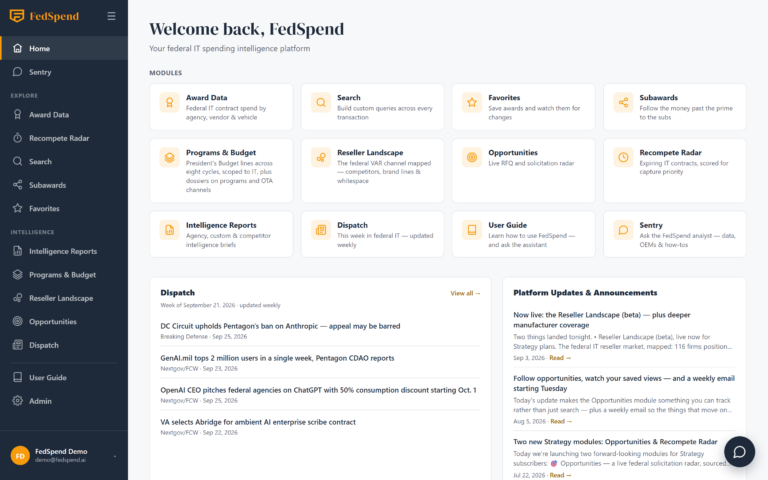
- FedSpend is purpose-built exclusively for federal IT vendors.
- Choose on use-case fit and data depth, not sticker price.
Two sales teams sit in the same demo. One sells copiers to school districts and fire trucks to counties. The other chases agency IT modernization dollars and IDIQ task-order recompetes. They are shown the same platform, quoted from the same undisclosed price sheet, and told it fits them both equally. It does not. That gap between “covers federal” and “built for federal” is where money quietly leaks out of a GovCon budget, and it’s the whole reason this comparison exists.
If you’re weighing GovSpend vs. FedSpend, you already know you need spend intelligence. The real question is which one was actually engineered for the budgets you sell into. Let’s take both apart on the merits.
What Is GovSpend? A Quick Primer
GovSpend is a public-sector procurement intelligence platform built primarily for the SLED market — state, local, and education — with federal coverage added later.
By its own description, GovSpend markets complete SLED depth spanning state agencies, counties, cities, school districts, higher education, and special districts, alongside federal data for a “whole-of-government” pitch. That breadth is the product’s identity and its selling point.
The federal piece has a specific origin. GovSpend’s federal award data comes from its 2021 acquisition of Fedmine, and the company itself was acquired by Thompson Street Capital Partners in January 2021, per verified procurement research. Most people searching “what is GovSpend” are mid-comparison, not curious. They want to know one thing before the demo call: is the federal data first-class, or bolted on? The honest answer is the latter — and that shapes everything downstream.
What Is FedSpend? The Federal-Focused Alternative
FedSpend is a federal-only spend intelligence platform built specifically for IT vendors tracking agency budgets, awards, and recompetes.
Where GovSpend spreads across five verticals, FedSpend narrows to one and goes deep. The entire data model is organized around federal contract and budget signals — the mechanics of how agencies actually obligate IT money. That’s a deliberate constraint, not a limitation.
Narrow scope buys you depth. When a platform only has to model FPDS award actions, agency budget justifications, and set-aside programs, it can tag IT spend the way a capture manager thinks about it, not the way a generalist database dumps it. FedSpend leans into that with tooling like its federal spend intelligence platform and award-level tracking, and it’s the same philosophy behind our deep dive on federal IT spending intelligence. Purpose-built beats multi-purpose when your revenue lives in one market.
How Do GovSpend and FedSpend Compare on Federal IT Data Depth?
GovSpend wins on breadth across every government market; FedSpend wins on depth inside federal IT specifically.
This is the section that should decide most purchases, so let’s be concrete. Both platforms ingest the same public federal foundations — FPDS contract actions and USASpending.gov obligations. The difference is what gets built on top.
| Capability | GovSpend | FedSpend |
|---|---|---|
| Primary market | SLED (state, local, education, healthcare) | Federal only |
| Federal award data | Via Fedmine (acquired 2021) | Native architecture |
| Core sources | 1,400+ sources, 9,500+ daily scrapers | FPDS, USASpending, agency budget docs |
| IT-specific tagging | General procurement categories | Federal IT-focused categorization |
| Recompete forecasting | Surface-level expiring contracts | Pipeline-oriented signals |
| SLED purchase-order data | 6.7M+ historical bids | Not covered |
Read that table honestly and GovSpend’s strength is obvious: 6.7M+ historical bids and quote-level purchase-order data from municipalities and school districts is genuinely hard to replicate, and its scraping footprint is enormous. If you sell hardware to a county, that’s gold.
But that same architecture is the problem for federal IT. GovSpend’s own outside pricing analysis concedes that its federal award search is “not differentiated” and that recompete tracking lacks probability scoring or an advance pipeline view. When a platform is optimized for school-district purchase orders, your FAR-compliance, set-aside, and task-order workflow is a guest in someone else’s house. FedSpend’s federal-only structure means those signals are the main event — the logic we unpack in our look at agency spending intelligence for IT vendors.
How Much Does GovSpend Cost? Pricing and Structure Explained
GovSpend does not publish pricing, and verified buyer data puts the typical range at roughly $7,450 to $42,054 per year, with a median around $11,600 as of Q2 2026.
That number isn’t a guess. It comes from an analysis of 34 verified purchase records compiled from Vendr procurement data and buyer-reported quotes. GovSpend’s site has product pages, case studies, and a “Request a Demo” button — but no price. Here’s the reported breakdown.
| Configuration | Approx. annual cost | What’s included |
|---|---|---|
| SLED-only, 1 seat | $7,450–$10,500 | State/local bid tracking, PO history, price comparison |
| Standard, 3–5 seats | $11,500–$16,000 | Adds Fedmine federal data, team seats, alerts |
| Professional, 5+ seats | $16,000–$20,000 | Full SLED + federal, agency tools, expanded scraping |
| Enterprise, multi-year | $20,000–$42,054+ | Custom integrations, dedicated support, multi-year lock-in |
Three details matter more than the headline figure.
Explore federal IT spending patterns free
Start a FedSpend trial to discover growth opportunities in $675B+ of federal IT awards.
- There is no federal-only tier. Fedmine is bundled into the core subscription, so a federal-only buyer still pays SLED-platform pricing for coverage they’ll never open.
- Multi-year deals cut 10–15% upfront but carry auto-renewal clauses that buyers report are difficult to exit.
- Renewals drift upward. Since the private-equity acquisition, users report 3%+ annual uplifts and rigid contract terms.
This is a lot of money for coverage a federal IT team may never use. Paying $11,500 to reach the tier that even includes Fedmine — then using maybe a third of the platform — is the definition of a diluted spend. It’s the same headline-number trap we’ve written about when vendors chase big budgets they can’t actually see into.
What Do Federal Sales Teams Actually Pay For With FedSpend?
FedSpend aligns cost with a single use case — federal spend intelligence — so you’re not subsidizing verticals outside your market.
The philosophy is the inverse of a bundle. Instead of paying for state, local, education, and healthcare data to reach the federal layer, FedSpend charges for federal depth alone. For a team whose entire pipeline is agency IT, that changes the value-per-dollar math before a single feature is compared.
Current plan details and figures live on the FedSpend pricing page — I won’t reproduce numbers here that may shift, and you should confirm them directly. What’s structurally different is what you’re buying: signal density in one market, not surface coverage across five. Lean GovCon teams especially feel that difference, because every dollar maps to a budget they can actually pursue.
Which Platform Matches Your Sales Motion?
Pick GovSpend if you sell across SLED and federal; pick FedSpend if your revenue is federal IT and depth beats breadth.
Use-case fit, not price, should drive this. Three scenarios cover most readers.
You sell across state, local, and federal markets
GovSpend is the stronger fit. If a real slice of your revenue comes from school districts, counties, or hospitals, its purchase-order data and SLED bid volume are difficult to match, and one platform covering the whole map has genuine operational value.
You’re a federal-only IT vendor or systems integrator
FedSpend fits better. When your workflow runs on set-aside programs, IDIQ ceilings versus actual obligations, and recompete timing, a federal-native data model gives you cleaner signal than a SLED platform with federal bolted on. Our writeup on which agencies steer IT spend to compliant platforms shows exactly the kind of federal-specific pattern generalist tools blur.
You’re a startup or lean GovCon team
FedSpend’s focus wins on budget efficiency. A five-person team can’t justify $11,500+ to unlock a federal layer they’ll use partially. Paying for federal depth alone is simply more rational when cash is tight and every outreach hour counts.
Quick self-assessment checklist:
- Is more than 30% of your revenue non-federal? Lean GovSpend.
- Do you live in set-asides, CPARS, and recompetes? Lean FedSpend.
- Do you need quote-level SLED purchase orders? Only GovSpend has them.
- Is transparent, federal-only pricing a dealbreaker? Lean FedSpend.
What GovSpend Alternatives Should Federal IT Vendors Consider?
Beyond FedSpend, the federal-intelligence landscape includes GovWin IQ, GovTribe, and Bloomberg Government.
Each has a niche. GovWin IQ is the federal enterprise incumbent, with pre-RFP intelligence and a reported median near $25,000/year — powerful, but priced for top-100 integrators with 10-person BD teams. GovTribe and Bloomberg Government round out the field. The takeaway for a federal IT vendor isn’t “shop endlessly.” It’s that a tool built for your niche will almost always out-signal a general-purpose platform, and you should shortlist accordingly rather than defaulting to the biggest brand.
The Bottom Line on GovSpend vs. FedSpend
GovSpend is the better whole-of-government platform; FedSpend is the better federal IT platform — and most readers of this site are the latter.
The decision comes down to three factors: data depth, pricing transparency, and vertical focus. GovSpend earns its price for teams selling across SLED, and it’s a credible federal option once you’re paying the bundle. But if your pipeline is agency IT budgets, you’re buying breadth you won’t use at a price you can’t see. A platform built for one market, priced for one market, beats a five-vertical database with federal stapled on. Explore the federal signal tooling FedSpend built for exactly this and judge it against your own pipeline.
