

- 92% of GovCon firms now use generative AI tools.
- AI excels at speed, scale, and consistent classification.
- Hallucination makes fully automated spend analysis risky for decisions.
- Federal spend data is frequently miscoded, duplicated, or late-filed.
- Hybrid AI-plus-analyst model consistently outperforms pure automation.
Nine out of ten federal contractors now say they use generative AI in some part of their business. In Deltek’s most recent GovCon Clarity study, 92% of respondents reported using generative AI — a figure that roughly doubled year over year. That number should make you skeptical, not excited. When a capability goes from novelty to near-universal in twelve months, the marketing gets ahead of the mechanics fast. This article separates what ai powered spend intelligence actually does today from the demo-friendly claims that fall apart the moment a contracting officer asks a follow-up question.
What Does AI-Powered Spend Intelligence Actually Mean?
AI-powered spend intelligence is the application of machine learning and natural-language processing to classify, tag, and surface patterns across federal spending data. That’s the plain-English version. The messy part is that the label covers two very different technical animals.
Traditional spend analysis ran on rules: if a contract carries this NAICS code and that agency, bucket it here. Reliable, but brittle, and blind to anything the rules didn’t anticipate.
The newer wave splits in two. Predictive machine learning models are trained for narrow jobs — classifying an award, matching a contract vehicle, flagging an anomaly. Generative systems, the gpt spend analysis services flavor, summarize documents and answer plain-language questions. When a vendor sells “gen ai spend analysis services,” ask which one they mean. Predictive ML and generative summarization fail in completely different ways. The gap between public-but-invisible federal spending records and genuine intelligence starts right here.
How Does Machine Learning Improve Government Spend Analysis?
Machine learning improves government spend analysis by automating the repetitive classification and pattern-matching that once ate an analyst’s week. The gains are real, and agencies are already buying in — 80% of chief procurement officers plan to deploy AI for spend analytics, contract management, and supplier selection within three years.
Narrow ML: classification, matching, anomaly detection
The workhorse use cases are unglamorous and valuable. Automated NAICS and PSC classification cleans up the coding chaos in raw award data. Contract-vehicle matching links an opportunity to the right IDIQ or schedule. Anomaly detection flags a spend trend that spikes off pattern — the kind of signal a capture team wants two quarters early, not after the solicitation drops. These narrow models do one thing and, when trained well, do it consistently across millions of transaction-level award records no human team could hand-tag.
Generative LLMs: summaries and natural-language queries
Layered on top of structured data, GPT-style models summarize a 200-page budget justification, draft a first-pass capture brief, or answer “what did the Army obligate on cloud last year?” in prose. Useful. But a general-purpose LLM stitched over a spend database is not the same as a model trained to classify that data — a distinction most sales decks quietly skip. USDA’s $300M Palantir data platform is a reminder that agencies pay for the plumbing, not the chatbot.
What Can AI Spend Analysis Tools Actually Do Well Today?
Today, AI spend analysis does three things better than any analyst: speed, scale, and consistency. Here’s where the tooling earns its keep.
- Speed — surfacing spend patterns across thousands of contracts in seconds, not days.
- Scale — reading volumes of unstructured procurement text no team could review manually.
- Consistency — cutting the manual tagging errors that creep into any large dataset.
Concrete example: point a GPT-style tool at an agency’s budget justification documents and it will compress a stack of PDFs into a readable summary of where the money is drifting. The federal acquisition community calls this the “assistive” phase — tools that reduce repetitive work rather than make decisions. That framing is honest. It’s also exactly what early market signals require: fast pattern recognition that hands a human something to act on.
Explore federal IT spending patterns free
Start a FedSpend trial to discover growth opportunities in $675B+ of federal IT awards.
Where Does AI Still Fall Short — and Why It Matters
AI still fails at judgment, context, and truthfulness under pressure — the exact places pipeline decisions live. This is the section vendors skip, so read it twice.
Start with hallucination. Generative models fabricate confidently, and the rate climbs on complex, high-stakes documents. The GAO has warned that generative AI can spread misinformation, and independent benchmarks on hard analytical tasks routinely show error rates well into the double digits. A summary of a budget document that invents an obligation figure isn’t a quirk — it’s a bid built on sand.
Context, politics, and data quality
Then there’s what the model can’t see. AI cannot read an agency’s informal signals — the reorg rumor, the program office that’s quietly out of favor, the CO who always re-competes rather than extends. That unwritten context shapes real buying behavior, and no model has access to it.
And the oldest problem of all: garbage in, garbage out. Federal spend data on USASpending.gov, FPDS, and SAM.gov is riddled with miscoded, duplicated, and late-filed records. AI applied to dirty data produces confident, well-formatted wrong answers — faster. Any vendor selling fully automated spend intelligence is asking you to bet a capture budget on outputs no human validated. Treat that claim the way you’d treat a $50M IDIQ ceiling with no obligations behind it: impressive on paper, empty until proven.
Why the Hybrid Model — AI Plus Human Analysts — Wins
The reliable model uses AI to compress the repetitive 80% of spend analysis so human analysts can spend their judgment on the 20% that actually decides deals. This is the whole argument in one sentence.
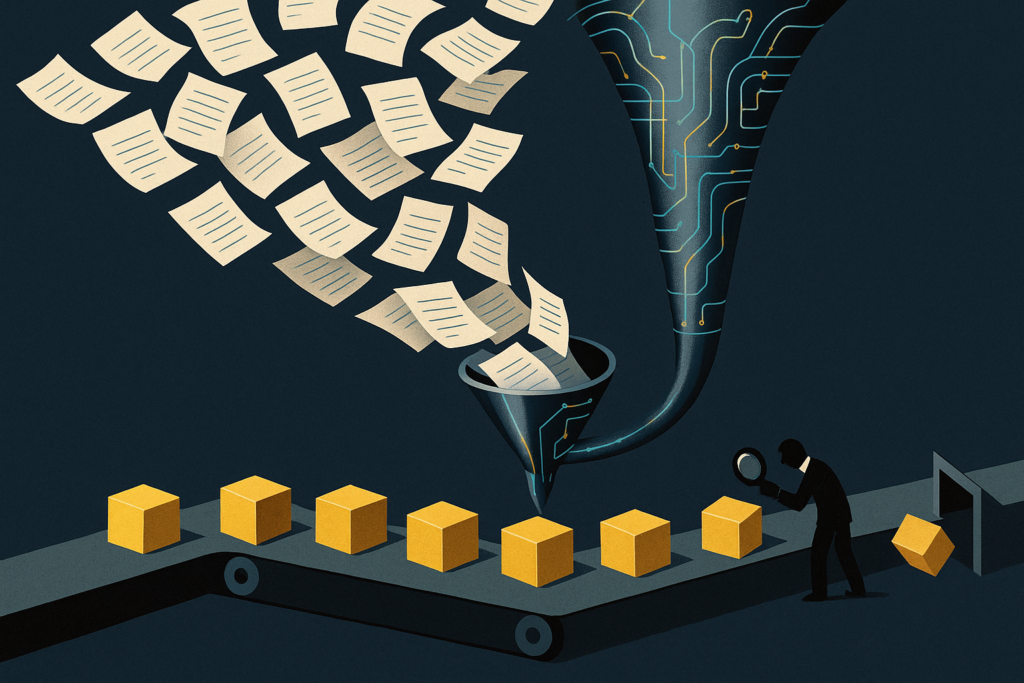
Let the machine do what it’s good at — classify at scale, flag anomalies, draft summaries. Then put an analyst who knows the agency, the vehicle, and the politics on top to validate, contextualize, and kill the false positives. That division of labor is why analyst-validated intelligence reports beat raw model output for teams making high-stakes pipeline calls.
The contrarian point: the demo that impresses you most is often the one lying most fluently. A pure-AI tool that never says “I don’t know” is a liability dressed as a feature.
| Task | AI alone | Human analyst | Hybrid |
|---|---|---|---|
| Classifying thousands of awards (NAICS/PSC) | Fast, consistent | Slow, tires | Best |
| Reading unwritten agency signals | Blind | Strong | Best |
| Summarizing budget justifications | Fast, hallucination risk | Accurate, slow | Best |
| High-stakes pipeline call | Risky | Reliable | Best |
How to evaluate an AI spend tool in five steps
- Ask whether the engine is predictive ML, a generative LLM, or both.
- Demand the data source and how often it’s cleaned and refreshed.
- Test it with a query you already know the answer to.
- Ask what happens when the model is uncertain — does it abstain or guess?
- Confirm whether a human validates outputs before they reach your pipeline.
The Honest Take: AI Is an Accelerant, Not an Oracle
AI has genuinely changed how fast you can read the federal market — the GAO found generative AI use cases jumped ninefold in a single year, and that curve isn’t bending back. But speed without judgment just gets you to the wrong conclusion faster. The teams that win won’t be the ones that automated their analysts away. They’ll be the ones who let the model handle the volume and kept a human on the questions that decide whether the money is real. Buy the accelerant. Don’t buy the oracle.
