
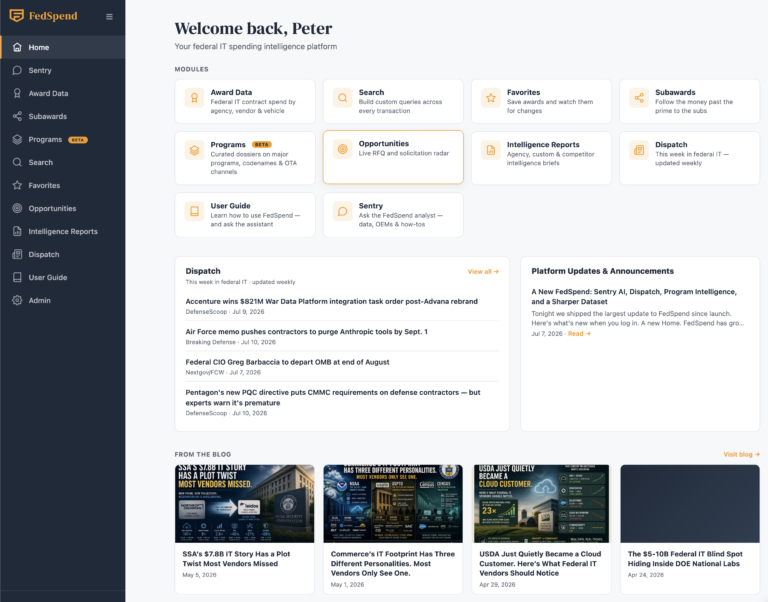


- GovTribe tracks live bids; FedSpend maps multi-year obligation patterns.
- Air Force IT spend rose roughly $1.6B over two fiscal years.
- VA concentrated 53% of FY2025 IT spend in just two PSC codes.
- GovTribe hides pricing; FedSpend publishes its plans openly.
- Most mid-market vendors need both tools, sequenced by weakest gap.
Here’s the mistake that costs mid-market federal IT vendors real money: they buy an opportunity-tracking tool, watch the RFP alerts roll in, and assume they now understand the market. They don’t. They know what’s posted. They have almost no idea what’s actually being bought, by whom, or through which codes the money has flowed for the last three fiscal years. That gap between the solicitation feed and the obligation history is where the GovTribe vs FedSpend question actually lives, and it’s not the feature fight most buyers think it is.
These two tools answer different questions. Confuse them and you’ll overspend on one job while leaving the other undone.
What GovTribe Is Actually Built For
GovTribe is opportunity-tracking software: it tells you what’s up for bid right now and who’s already circling it.
The comparison at a glance, before we go deeper:
| Dimension | GovTribe | FedSpend |
|---|---|---|
| Core question | “What’s open for bid, and who’s involved?” | “What’s actually being bought, by whom, at what volume?” |
| Primary data | Live solicitations, amendments, award/vendor profiles | Multi-year agency obligations by PSC and NAICS |
| Time orientation | Present + near-term pipeline | Backward-looking spend patterns and trends |
| Best for | Capture teams managing active bids | BD leads deciding which agencies/categories to target |
| Public pricing | Not published; sales quote required | See plans page |
GovTribe pulls from SAM.gov, FPDS, and USASpending and puts a faster interface on top. According to a 2026 RFP Recon teardown, GovTribe was acquired by GovExec in 2019 and now aggregates opportunity data, contract award histories, and agency profiles in a cleaner UI than the government-native sources. Its award-history and vendor-profiling features are genuinely strong. GovBrew readers have voted it a favorite federal market-intelligence tool, and that reputation is earned on interface and alerting.
One thing to flag plainly: GovTribe does not publish tier pricing. You call sales for a quote. For a shop with a $40K BD budget, a tool that hides its price before a discovery call is negotiating on its terms, not yours.
What FedSpend Is Actually Built For
FedSpend is spend-pattern analytics: it shows which agencies obligate the most on IT, broken out by product/service code and NAICS, tracked across fiscal years.
The framing is analyst-report, not alert-feed. Instead of “an RFP dropped this morning,” FedSpend answers “the Air Force has spent more on application-development labor every year since FY2023, and here’s the multi-year curve.” That’s a different job from bid tracking, and it’s the layer most mid-market vendors are missing when they walk into a proposal. You can explore the underlying obligation records through the award data platform, or read the packaged analysis in FedSpend’s intelligence reports.
Every figure below carries its fiscal year and transaction count, because an obligation number without its sample size is a headline, not evidence — a point we make often about reading agency spending intelligence.
Why the Question Each Tool Answers Actually Matters
GovTribe answers “what’s up for bid”; FedSpend answers “what’s being bought” — and vendors who conflate the two misallocate their BD budget.
Explore $492B in federal IT spend
Try FedSpend free for 14 days. Full dashboard access, no credit card required.
Picture the failure mode. A capture lead sees a live Air Force solicitation, mobilizes, and writes a proposal — blind to the fact that the agency routes the overwhelming majority of its IT dollars through a handful of codes that may not include the one they’re bidding. The bid feed told them a door was open. It didn’t tell them which doors the money actually walks through. That’s the distinction between federal spend intelligence and solicitation tracking.
A Real Look at the Spend Patterns FedSpend Surfaces
The Air Force spent $12.01 billion on IT across 22,460 transactions in FY2025, and the concentration is the story.
Per FedSpend’s agency-spend dataset (as of September 1, 2026), the top five product/service codes account for roughly 45% of that $12.01B. Application-development support labor (DA01) alone drew $2.39B; application-development software-as-a-service (DA10) took $1.07B. This isn’t one lucky year. Track it back:
| Air Force IT spend | Total obligations | Transactions | DA01 (app-dev labor) |
|---|---|---|---|
| FY2023 | $10.38B | 21,860 | $1.57B |
| FY2024 | $11.29B | 22,133 | $2.02B |
| FY2025 | $12.01B | 22,460 | $2.39B |
That’s a climbing line, not a spike — obligations up roughly $1.6B in two years, with app-dev labor leading every year. A single solicitation can’t tell you that. The pattern can.
Concentration also differs sharply by agency, which is the whole point. The Department of Veterans Affairs obligated $9.46B across 12,426 transactions in FY2024, with DA01 app-dev labor at $3.03B — a heavier tilt toward development labor than the Air Force. By FY2025, the VA’s top two codes alone (app-dev labor plus SaaS) made up 53% of its $9.40B IT spend. Same broad category, different center of gravity. A vendor selling SaaS should read those two agencies completely differently, and only spend-pattern data tells you how.
Where GovTribe Still Wins Outright
For day-to-day capture work, GovTribe does things FedSpend doesn’t try to do.
- Real-time alerts on new solicitations, amendments, and deadline changes.
- Incumbent identification at the contract level and vendor competitor profiles.
- Workflow for a capture team actively managing a live pipeline.
Be honest about this: FedSpend is not a bid-tracking replacement. If your problem is “I need to know the moment an amendment posts,” GodTribe or a similar alert tool is the right buy. FedSpend won’t ping you when a deadline moves.
Which Gap Should a Budget-Conscious Vendor Fill First?
Fill the gap that’s actually costing you wins — and for most mid-market vendors, that’s the targeting layer, not the alert layer.
- You already have a bid pipeline but keep losing. If you’re chasing 40 opportunities and winning three, your problem is target selection, not visibility. Spend-pattern data tells you which agencies and codes to concentrate on. Buy that first.
- You have market intel but no bid tracking. If you understand the spend landscape but keep missing live solicitations and amendments, an opportunity tracker like GovTribe fills that gap first.
- You have neither and a real budget. Sequence by your weakest link, then add the other within a quarter.
Most mid-market vendors eventually need both. The honest framing isn’t either/or — it’s ordering. And because GovTribe hides its price behind a sales call while FedSpend’s targeting layer starts cheaper, the sequencing question is usually a budget question, not a preference one. If you’re weighing leaner options against enterprise suites, our look at how spend-intelligence platforms fit different sales teams covers the same trade-off.
The Verdict for Mid-Market BD Teams
Stop treating this as a duel. GovTribe and FedSpend aren’t fighting over the same job — one watches the door, the other maps where the money walks. Choose GovTribe if your bottleneck is live pipeline management, amendments, and incumbent tracking. Choose FedSpend if you keep bidding into agencies and codes that were never going to fund you, because that’s the leak spend-pattern data plugs. Audit your own stack against the two questions before you spend a dollar — most teams discover they’ve been paying for door-watching while flying blind on the map, and that’s exactly backward.
