


- Five daily browser tabs were reassurance, not real research.
- One weekly Dispatch digest replaces scattered checking in ten minutes.
- Context-switching between tabs costs roughly 23 minutes of focus each time.
- News monitoring and award data tools serve different, complementary roles.
- Federal IT's news pace suits a weekly review, not daily tab-checking.
Monday mornings used to start the same way for Priya, an account exec selling network modernization software into civilian agencies: five tabs open before the coffee finished brewing. A federal IT trade site. SAM.gov. An agency press room. A second trade site, because the first one missed something last month. By Tuesday of this week, all five tabs had been replaced by one email.
Monday: The Old Habit, Still Running on Autopilot
The old Monday ritual wasn’t research, it was reassurance — a scroll through five sources to confirm nothing happened over the weekend. The habit persisted less because it worked and more because stopping felt risky.
| Monitoring Task | Old Daily Habit | With a Weekly Dispatch |
|---|---|---|
| Trade press scan | Checked 1–2 times daily, 5 days a week | Summarized once, Tuesday morning |
| SAM.gov monitoring | Manual refresh, no consolidation | Not part of the digest; handled separately |
| Agency news/press rooms | Checked ad hoc, source by source | Pulled into one curated roundup |
| Mental load | “Did I miss something?” daily | Resolved once a week |
Tuesday Morning: Dispatch Lands — The Brief and The Feed
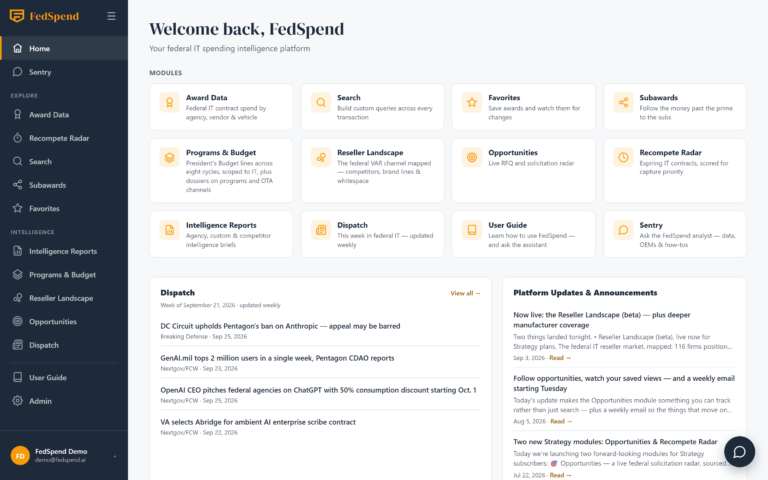
Dispatch arrives once, on Tuesday, and replaces the entire week of scattered checking in about ten minutes. It lands in the inbox the same way her Monday pipeline review already does, as part of a predictable weekly rhythm rather than another thing to remember.
Reading both takes a fraction of the time the old routine cost across five days. That math isn’t exotic. A 2025 study out of the University of California, Irvine found it takes roughly 23 minutes to refocus after switching between unrelated digital tools — which means five tab-checking interruptions a day were never free, even on a slow news week.
| Section | What It Is | Best For |
|---|---|---|
| The Brief | Short, scannable summary of the week’s most relevant developments | A two-minute read before a Tuesday pipeline call |
| The Feed | Broader roundup from roughly a dozen curated federal IT and trade sources | Deeper context before an account-specific conversation |
For readers who want the feature-level breakdown, the standalone Dispatch explainer covers it in more depth. For this week, Priya just reads it.
Tuesday Afternoon: Turning Dispatch Into Talking Points
The Feed isn’t just background reading — it’s the opener for an afternoon call that used to start with weather talk. Priya has a 2 p.m. with an IT program contact she’s been courting for two quarters, and instead of small talk, she references a modernization item from that morning’s Feed that touches his bureau. It signals she’s paying attention to his world, not just her pipeline.
Where Dispatch Fits Next to Award Data
Dispatch doesn’t replace account-level number-crunching — it sits next to it. FedSpend’s own Award Data platform tracks $675B+ in federal IT obligations across 2.4M+ transactions and 74 agencies, FY2020 through FY2026 year-to-date as of late September 2026. Before the call, Priya checks a starred award to confirm the contract she wants to reference is still active. The gap between a headline and actual obligations is where calls go sideways if a rep only has half the picture. On the Intelligence plan, that half comes from:
Explore federal IT spending patterns free
Start a FedSpend trial to discover growth opportunities in $675B+ of federal IT awards.
- Award Data — obligations by agency, PSC, NAICS, and contract vehicle.
- Favorites — starred awards flagged when new transactions or obligation changes arrive.
- Sentry — an in-app analyst for quick questions against live data.
- Agency quarterly Intelligence Reports — published context on where a given agency’s IT budget is moving.
Wednesday: Why There’s Nothing Left to Check
The old Wednesday habit was re-checking trade press out of pure muscle memory, not because anything new was likely. This week, there’s nothing to re-check. Dispatch already covered the week’s news on Tuesday, and the next edition isn’t until next Tuesday.
Instead, Priya spends ten minutes on Favorites, checking obligation changes on starred awards, and opens Sentry to ask a quick question about a vehicle she’s tracking. That’s live-data work, not news-scanning. The freed-up time goes back into selling, which matters more than it sounds: a Forrester study of 3,031 reps found the average seller burns nearly two full days a week on activity that isn’t selling at all.
Thursday and Friday: Pipeline Work Without the News Noise
The back half of the week looks almost boring, and that’s the point — it’s account research and proposal prep, not news triage. No new trade-press tabs open. No SAM.gov refresh out of habit.
- Thursday morning: proposal language review for a recompete, checked against how competitive that category of recompete tends to run.
- Thursday afternoon: outreach to two warm contacts, referencing an item still sitting in last Tuesday’s Feed.
- Friday morning: prep for an Air Force meeting using a quarterly Intelligence Report, with the Air Force IT budget breakdown as backup context on where that spend concentrates.
She saves one Dispatch item on a modernization initiative worth revisiting once the agency’s next budget cycle firms up, rather than losing it in a browser tab closed by accident. Small thing. Anyone who’s lost a half-remembered headline to a closed tab knows it isn’t nothing.
The Following Monday: What Actually Changed
The second Monday feels different for one reason: no scanning ritual, no residual fear of having missed something over the weekend. Nothing dramatic happened. No headline was missed. That’s the realization that matters.
By the time the next Dispatch lands, Priya trusts it will cover what mattered in the week behind her. That trust is the whole mechanism. Federal IT news doesn’t move slowly — agencies reorganize, contracts get awarded, budgets shift — it just doesn’t move fast enough to justify checking five sources a day to catch it. A weekly roundup fits the real pace of the news better than the daily habit ever did. This isn’t doing less work. It’s doing the monitoring part of the job in one sitting instead of ten.
The Tab Sprawl Was Never a Sign of Diligence
Five open tabs looked like thoroughness. It was mostly anxiety dressed up as research. The federal IT news cycle doesn’t reward checking it ten times a week instead of once — it rewards being prepared for the items that actually touch your accounts, and reps who trust a structured weekly rhythm get that coverage back without the tab sprawl. That’s a trade worth making, and the only real cost of testing it is a week of an old habit dying slowly.
